Qipao Explained: The History, Style and Cultural Meaning of China's Iconic Dress
Explore the qipao or cheongsam: its roots, 1930s Shanghai fashion, Hong Kong tailoring, signature details, and how people wear it today.
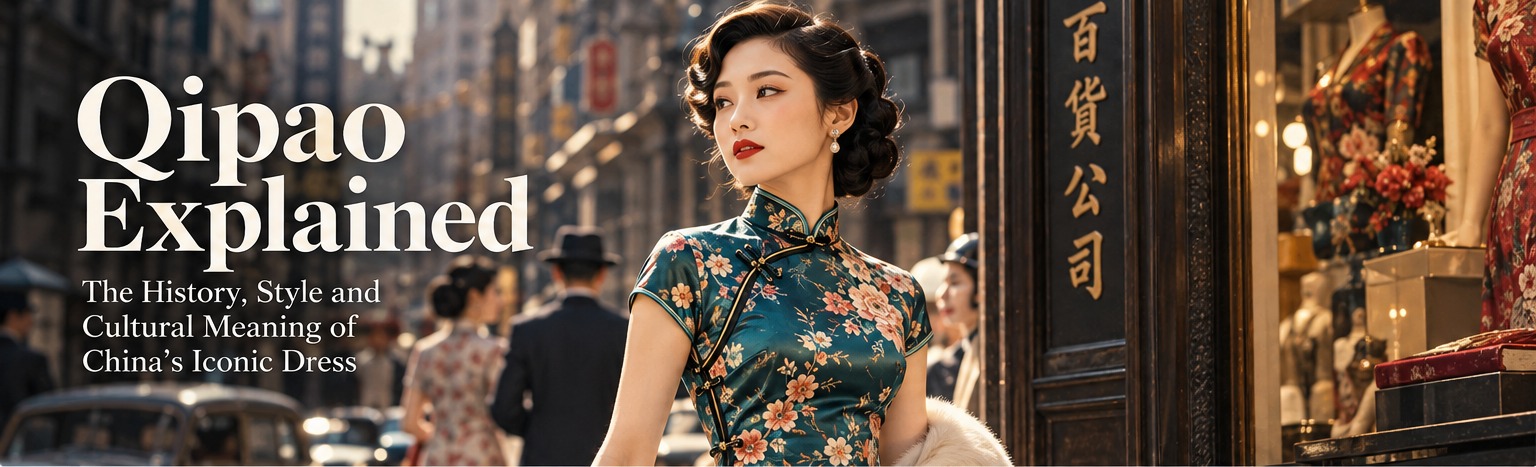
Picture a street in Shanghai in the 1930s. A woman steps out of a department store in a long dress with a high collar, fabric-covered buttons, and a beautifully shaped silhouette. Her outfit might be silk with a floral pattern, or a fashionable imported textile. She is not necessarily attending a ceremony: she may simply be wearing the latest urban fashion.
The dress is a qipao (旗袍, qípáo), also widely known as a cheongsam. Today it is often called traditional Chinese clothing. Yet the fitted version familiar to many people is also a product of twentieth-century fashion, shaped by changing ideas about women’s lives, international influences, and the work of Chinese tailors. Its history is much more interesting than the idea of an ancient dress preserved unchanged.
What Is a Qipao?
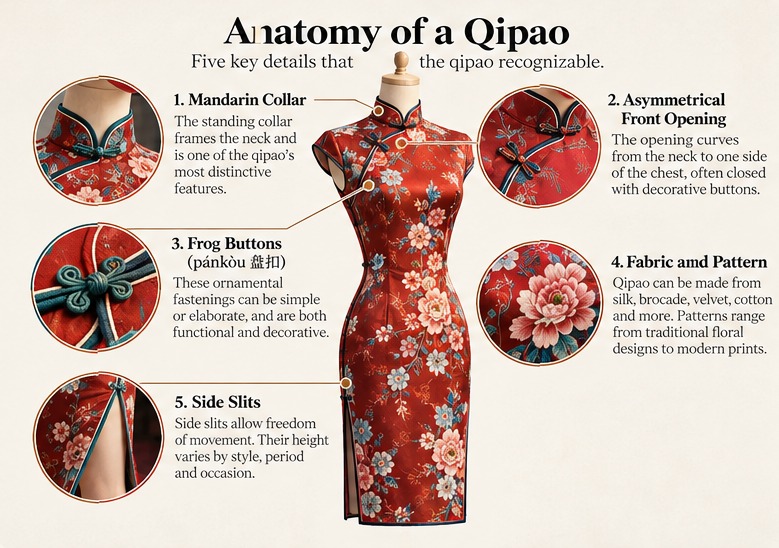
A qipao is a one-piece dress associated with Chinese women’s fashion, particularly the styles developed during the twentieth century. Common features include a standing collar, an asymmetrical opening near the neck, decorative fabric fastenings, a streamlined silhouette, and side slits. Materials range from silk and brocade to cotton, velvet, and modern blends.
Not every qipao is tight-fitting, sleeveless, or cut with high slits. Early modern examples could be loose and ankle-length, with long sleeves. Later fashions introduced closer waists, different hems, shorter sleeves, and new textiles. Think of the qipao as an evolving family of designs, not one unchanging uniform.
Qipao or Cheongsam: What’s the Difference?
Qipao (旗袍) is the Mandarin name, historically connected to the robes of the Manchu banner population. Cheongsam comes from Cantonese 長衫 / 长衫, meaning “long gown.” The Cantonese expression has a broader history and has also referred to men’s long gowns, but in modern international fashion it commonly names the same women’s dress as qipao.
On the Chinese mainland, qipao is usually the more practical word to use. In Hong Kong and English-language fashion writing, cheongsam is especially familiar. The names do not necessarily describe different styles.
Where Did the Qipao Come From?
The qipao’s history is linked to the clothing traditions of the Manchu people, who established the Qing dynasty in 1644. Long robes worn by Manchu women contributed to the garment’s later identity. But the modern qipao is not simply a Qing robe with a narrower waist. Its development also reflects early-twentieth-century changes in tailoring, textile production, urban fashion, and women’s preferences.
Scholars debate the precise relationship among Manchu robes, other Chinese clothing traditions, and contemporary fashions. What is clear is that the modern qipao became especially prominent during the Republican era, after the Qing dynasty ended in 1911. Calling today’s familiar fitted qipao a “4,000-year-old dress” would therefore be misleading.
Why Shanghai Became the Fashion Capital of the Qipao
Shanghai in the 1920s and 1930s was a center of international commerce and urban popular culture. Department stores, cinema, magazines, advertisements, and imported fabrics helped circulate new ideas about how women could dress. The qipao was part of that changing world.
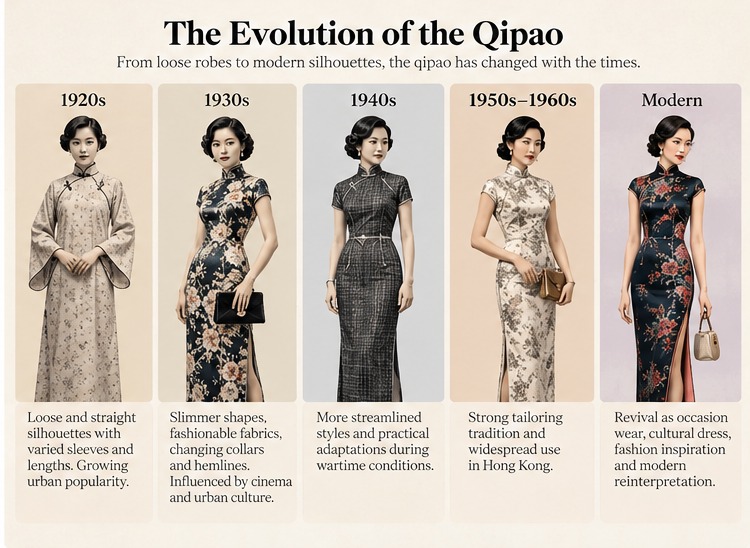
In the 1920s, many fashionable qipao were relatively loose and straight. During the 1930s, tailors increasingly experimented with shaped seams and closer fits, while collar heights, sleeve lengths, and hems changed with fashion. Designs could use traditional silk motifs or geometric patterns associated with contemporary international style.
Actresses, fashion photography, and commercial calendar posters helped make the qipao a symbol of urban sophistication. Yet it was not only a glamorous evening dress. Women also wore practical versions for school, work, social visits, and everyday life. A cotton day dress and an elaborate silk evening qipao could look very different.
How the Qipao Changed Over Time
1920s: often loose, straight silhouettes with varied sleeves and lengths. 1930s: slimmer cuts, changing collars and hemlines, and a wider range of fashionable fabrics. 1940s: streamlined and practical adaptations amid wartime conditions. 1950s–1960s: skilled cheongsam tailoring and widespread use in Hong Kong. Today: formal occasion wear, heritage dress, contemporary fashion, and new interpretations. These are broad trends, not rigid rules: styles overlapped across cities and decades.
The following illustration is an interpretive style comparison, not a collection of dated museum garments.
The Hong Kong Chapter: How Cheongsam Tailoring Continued
Hong Kong became another major center for cheongsam craftsmanship. During the twentieth century, experienced tailors arrived from Shanghai and other Chinese cities, bringing skills in pattern cutting, fitting, sewing, and finishing. In the 1950s and 1960s, cheongsam were worn by office workers, teachers, actresses, and women attending social occasions.
A well-made cheongsam is defined by more than expensive fabric. The collar should sit comfortably, the shoulders and chest should allow movement, and the waist should follow the wearer without pulling. Seams, fastenings, and slit placement influence both appearance and practicality. Custom tailoring may involve careful measurements and multiple fittings.
Five Details That Make a Qipao Recognizable
1. Mandarin collar: a standing collar that frames the neck; its height varies. 2. Asymmetrical opening: a distinctive curved closure near the upper chest. 3. Frog buttons (盘扣, pánkòu): decorative fabric knots that may be functional or ornamental. 4. Side slits: help with movement in narrower dresses; their height is not fixed. 5. Fabric and pattern: silk, brocade, cotton, velvet, modern blends, floral motifs, or geometric prints can all appear.
These details help you appreciate the garment’s construction, but not every historical or contemporary qipao includes every feature in the same form.
Qipao vs. Hanfu: Are They the Same?
No. Hanfu (汉服, hànfú) generally refers to clothing traditions associated with Han Chinese people and their modern revivals, encompassing many periods and garment forms. The qipao is especially associated with the evolution of modern Chinese women’s dress in the twentieth century, while retaining older influences.
A qipao is commonly a one-piece dress with a standing collar and side closure. Many hanfu styles use overlapping robes, separate upper and lower garments, broad sleeves, belts, or sashes. Neither category represents every form of clothing worn throughout Chinese history, and neither should be treated as the only authentic Chinese national costume.
Why the Qipao Became a Symbol of Chinese Elegance
The qipao has carried different meanings in different periods. For some early-twentieth-century urban women, it represented modernity and participation in public life. For later generations it might evoke Shanghai, Hong Kong, family photographs, or memories of an earlier fashion era. For people overseas it can be a connection to Chinese heritage. For designers, it is a recognizable starting point for new ideas.
Film has helped shape its international image. In Wong Kar-wai’s In the Mood for Love (2000), Maggie Cheung’s fitted cheongsams help establish the atmosphere and the character’s emotional world. These beautiful cinematic costumes are memorable, but they do not show the full range of historical everyday qipao.
When Do People Wear Qipao Today?
For most women in mainland China, the qipao is not ordinary daily clothing today. It is more often worn at weddings, Chinese New Year celebrations, formal dinners, cultural events, graduations, performances, or fashion shoots. Modern qipao-inspired dresses also appear in everyday fashion, with lower collars, shorter hems, and casual fabrics.
Can Foreigners Wear a Qipao?
Generally, yes: wearing a qipao is not restricted to people of Chinese heritage. Context matters. Wearing one respectfully at a celebration or cultural event is different from using the clothing as a joke or presenting a caricature of Chinese people. If attending someone else’s event, consider the dress code and the hosts’ preferences. Views on cultural appropriation vary, so curiosity and respect are better guides than assuming everyone shares one opinion.
How to Choose Your First Qipao
- Choose for the occasion: silk and brocade can suit formal events; cotton and other comfortable materials can work for casual wear.
- Try sitting and walking: a dress should not restrict breathing or movement.
- Check the collar: it should sit neatly without pressing against your neck.
- Inspect the closures, seams, lining, and slits: construction affects comfort and durability.
- Do not assume silk is always best: choose fabric for climate, care, and how often you will wear it.
Useful Chinese Words for Shopping for a Qipao
- 旗袍 (qípáo) — Qipao / cheongsam
- 汉服 (hànfú) — Hanfu
- 盘扣 (pánkòu) — Decorative frog buttons
- 领子 (lǐngzi) — Collar
- 丝绸 (sīchóu) — Silk
- 尺码 (chǐmǎ) — Clothing size
- 试穿 (shìchuān) — To try on clothes
- 定制 (dìngzhì) — Custom-made
- 合身 (héshēn) — To fit well
- 改衣服 (gǎi yīfu) — To alter clothing
我想试穿这件旗袍。 Wǒ xiǎng shìchuān zhè jiàn qípáo. — “I’d like to try on this qipao.”
有大一号的吗? Yǒu dà yí hào de ma? — “Do you have one size larger?”
可以定制吗? Kěyǐ dìngzhì ma? — “Can it be custom-made?”
Frequently Asked Questions
Is qipao the same as cheongsam? In most modern contexts, yes. The terms have different linguistic histories but commonly refer to the same women’s dress.
Is the qipao from the Qing dynasty? It has connections to Manchu clothing traditions, but the modern dress developed significantly in the twentieth century.
Why do qipao dresses have side slits? They help with movement in a narrow skirt; slit height varies by style and purpose.
Do Chinese women wear qipao every day? Most do not today. It is often occasion wear, although casual modern versions exist.
What is the difference between qipao and hanfu? Qipao is especially associated with modern Chinese women’s fashion; hanfu encompasses a broader set of Han Chinese clothing traditions and revivals.
More Than a Beautiful Dress
The qipao connects the robes of Qing-era Manchu communities with Republican Shanghai fashion, Hong Kong tailoring, film, and contemporary design. It was never simply a dress frozen in the past. It evolved because the people who made and wore it were changing, too. To appreciate a qipao is to see not only its elegant silhouette, but the creativity, craftsmanship, and social history stitched into the fabric.
Further Reading
For additional research, consult the Victoria and Albert Museum’s fashion collections, Hong Kong Memory’s materials on cheongsam history, and museum exhibitions on Chinese dress. Historical images should be checked against collection dates and provenance; the illustrations in this article are artistic reconstructions rather than archival photographs.