Peking Opera Explained: Face Paint, Characters, Music and How to Watch
Understand Peking Opera’s face paint, four role types, stylized movement, music, famous plays, and how to enjoy your first performance.
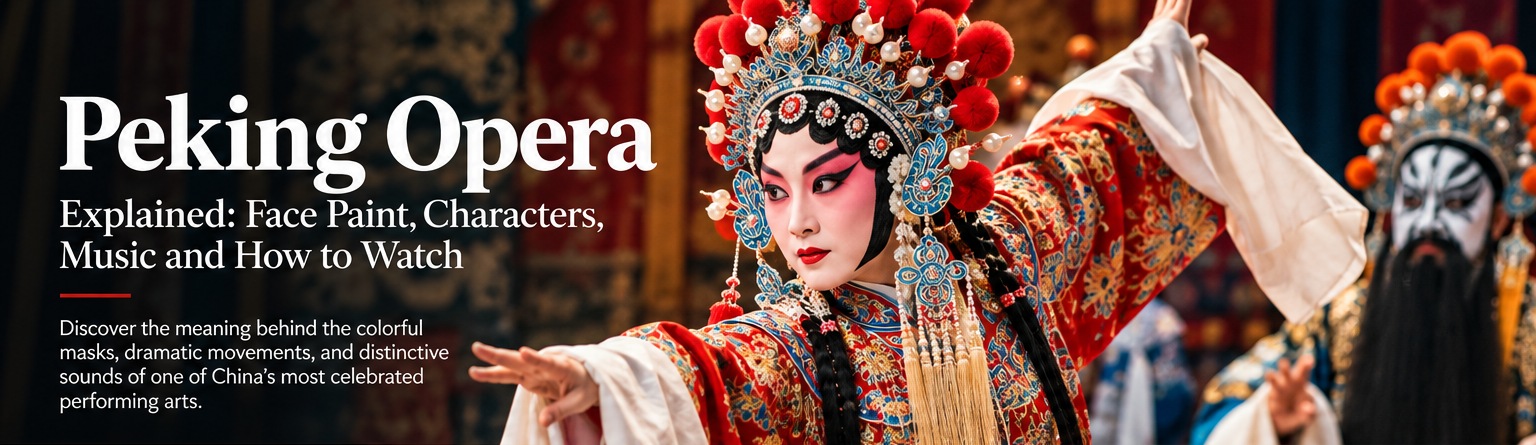
A clash of cymbals. An embroidered robe. A performer whose face is painted in vivid colors steps onto a nearly empty stage. With a few deliberate movements, the performer can suggest a palace, a battlefield, or a journey on horseback. This is Peking Opera—京剧 (Jīngjù)—a theatrical art that asks you to read gestures, music, costume, and voice together.
You do not need to speak Mandarin to enjoy it. Understanding a handful of conventions makes the experience much more rewarding. Here is how to recognize the characters, interpret the makeup, listen to the music, and choose a performance for your first visit.
What Is Peking Opera?
Peking Opera, also called Beijing Opera, combines singing, stylized speech, acting, dance-like movement, and martial arts. Its stories draw on history, classical literature, legends, family relationships, and questions of loyalty and duty. Unlike realistic theater, it often uses minimal scenery: performers create the setting through familiar gestures and carefully chosen props.
The form emerged in Beijing during the nineteenth century from exchanges among older regional theatrical traditions. The arrival of Anhui troupes for the Qianlong Emperor’s eightieth-birthday celebrations in 1790 is often cited as an important milestone, although the art developed over decades rather than appearing at once. UNESCO inscribed Peking Opera on its Representative List of the Intangible Cultural Heritage of Humanity in 2010.
Why Are Some Faces Painted Red, White, or Black?
The striking makeup is called 脸谱 (liǎnpǔ), often translated as facial patterns or face paint. It is especially associated with the jing, or painted-face, role category. Not every performer wears elaborate full-face designs. Makeup works alongside costume, voice, and movement to help audiences identify a dramatic character.
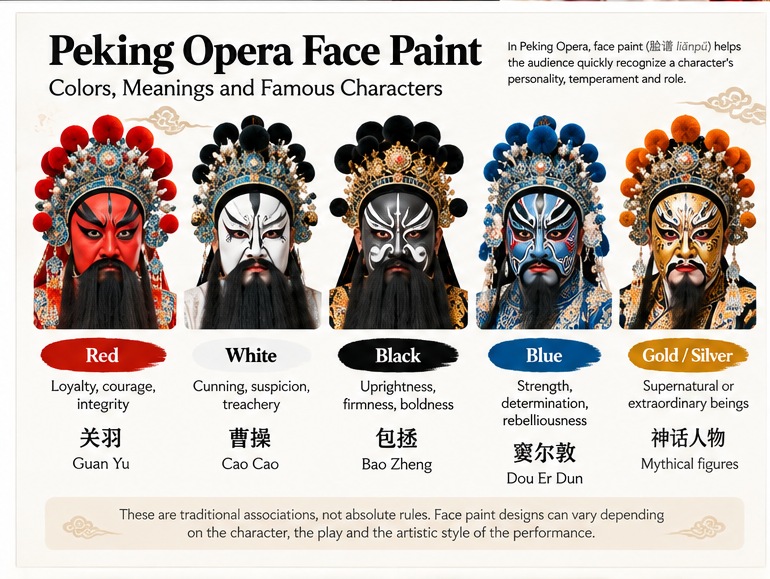
Red is often associated with loyalty and courage; Guan Yu is a famous example. White can suggest cunning or treachery in a theatrical portrayal, as with Cao Cao. Black often suggests firmness and integrity, as in the popular image of the judge Bao Zheng. Blue can suggest a forceful or rebellious temperament; gold and silver often appear in portrayals of extraordinary or supernatural beings.
These are tendencies, not a universal code. Specific patterns, characters, and dramatic traditions matter. Cao Cao, for example, was a complex historical figure; his stage portrayal is not a complete historical verdict. Avoid assuming that every red face is good or every white face is bad.
The Four Main Roles: Sheng, Dan, Jing, and Chou
Peking Opera performers specialize in role categories called 行当 (hángdang). The four broad families are 生 (shēng), 旦 (dàn), 净 (jìng), and 丑 (chǒu). Each has conventions for voice, movement, costume, and characterization.
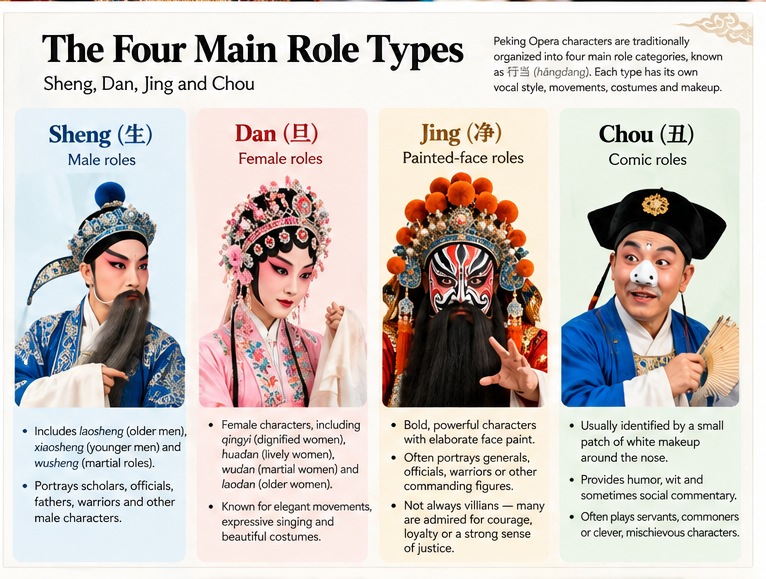
Sheng refers broadly to male roles other than painted-face and comic roles. Laosheng are often mature men, such as officials or fathers; xiaosheng are younger male characters; wusheng specialize in martial performance. Their vocal and physical techniques differ markedly.
Dan encompasses female roles. Qingyi often emphasizes dignified characters and sustained singing; huadan often features lively, expressive characters; wudan requires martial skills; laodan portrays older women. Historically, some celebrated dan specialists were men, including Mei Lanfang (1894–1961), whose performances helped introduce the art internationally. Women also perform these roles today.
Jing roles are usually bold, forceful characters with distinctive facial makeup and powerful delivery. They may be generals, officials, or other commanding figures, and they are not automatically villains. Chou roles use wit, comic timing, and sometimes social satire; a small white patch around the nose is a common visual clue.
Why Does a Nearly Empty Stage Feel Like a Whole World?
Peking Opera is built on stylization rather than literal imitation. A whip can suggest a horse. A performer may mime opening a door that is not physically there. A table and two chairs can become a domestic room or an official setting. What matters is not the prop alone, but the shared conventions that tell the audience what it means.
Watch the feet, hands, and eyes. A slow turn, a pause, or a controlled glance may reveal a change in mood. Long white fabric extensions called 水袖 (shuǐxiù), or water sleeves, can be flicked, gathered, and swept to amplify gestures and emotion. The virtuosity lies in precision: the movement is both symbolic and beautiful.
Four Skills Behind the Performance
Traditional training emphasizes 唱、念、做、打 (chàng, niàn, zuò, dǎ): singing, recitation, acting, and martial performance. Singing carries emotion through stylized melodies. Recitation uses theatrical rhythm and vocal delivery rather than ordinary conversation. Acting includes codified gestures, posture, and expression. Martial performance transforms conflict into coordinated combat and acrobatics.
A short battle scene may demand years of physical training. The performers need balance, timing, and mutual trust, not simply the ability to handle a prop weapon.
What Does Peking Opera Sound Like?
The sound can be startling to first-time listeners: piercing bowed strings, highly stylized voices, and emphatic gongs and drums. The 京胡 (jīnghú), a small two-stringed bowed instrument, is closely associated with the form. Percussion marks entrances, tension, movement, and combat, sometimes conveying dramatic urgency before a character sings a note.
Two major melodic systems are 西皮 (xīpí) and 二黄 (èrhuáng), each with variations in pace and expression. You do not need to identify them immediately. Listen instead for changes: when does the rhythm accelerate, when does a phrase stretch, and when does percussion interrupt? Those changes are part of the storytelling.
Three Famous Stories to Start With
Farewell My Concubine (霸王别姬, Bàwáng Bié Jī) tells of Xiang Yu and Yu Ji as his military fortunes collapse. Its emotional power comes from loyalty, love, and loss. The famous film of the same English name is a different work that draws on the world of Peking Opera; it should not be confused with the stage play.
The Empty City Strategy (空城计, Kōng Chéng Jì) centers on Zhuge Liang, who faces an enemy with too few troops. He appears untroubled and plays an instrument above the city gate, leading his opponent to suspect a trap. The tension comes from psychology rather than elaborate scenery.
Havoc in Heaven (闹天宫, Nào Tiān Gōng), featuring the Monkey King from Journey to the West, is an energetic entry point for newcomers. Its acrobatics, martial movement, and colorful staging can be enjoyable even without understanding the dialogue.
How to Enjoy Your First Performance
First, read a brief plot synopsis. It is much easier to appreciate the acting when you already know the central conflict. Second, check whether the production offers English surtitles or translated program notes; not every venue does. Third, consider a shorter excerpt or a program with several scenes before committing to a long traditional performance.
During the show, do not try to translate every line in your head. Follow entrances, posture, sleeve movements, and percussion cues. Notice when a character’s role type becomes obvious from costume or voice. Minimal scenery is intentional: the audience completes the world imaginatively.
Where to Watch Peking Opera in Beijing
Beijing has a longstanding Peking Opera performance tradition. Chang’an Grand Theatre (长安大戏院) is associated with traditional opera productions. Liyuan Theatre (梨园剧场) has historically offered visitor-oriented Peking Opera programs. Schedules, operating arrangements, subtitles, and ticketing can change, so verify a current performance directly with the venue or an authorized ticket provider before making plans.
Useful Mandarin for Your Visit
京剧 (Jīngjù) — Peking Opera; 脸谱 (liǎnpǔ) — theatrical facial makeup; 生 (shēng) — male roles; 旦 (dàn) — female roles; 净 (jìng) — painted-face roles; 丑 (chǒu) — comic roles; 水袖 (shuǐxiù) — water sleeves; 戏迷 (xìmí) — opera enthusiast.
我想看京剧。 Wǒ xiǎng kàn Jīngjù. — “I want to watch Peking Opera.”
有英文字幕吗? Yǒu Yīngwén zìmù ma? — “Are there English subtitles?”
Frequently Asked Questions
Is Peking Opera the same as Beijing Opera? Yes. “Peking” is an older romanization of Beijing and remains common in the art form’s English name.
Do performers wear masks? The characteristic face designs are usually painted directly onto the skin, rather than worn as removable masks.
Can you enjoy it without speaking Chinese? Yes. A synopsis, an excerpt with strong physical storytelling, and English surtitles where available can make a major difference.
Is it still performed today? Yes. Companies, artists, training institutions, and festivals continue to perform and teach the tradition.
A Different Way to See Theater
Peking Opera rewards attention. A face pattern can introduce a personality; a few steps can become a long journey; a sleeve can reveal grief or hesitation. Once you understand the conventions, the nearly empty stage begins to feel surprisingly full. The best way to learn more is to watch a scene, notice what puzzles you, and then watch again.
Sources and Further Reading
UNESCO, “Peking Opera”: https://ich.unesco.org/en/RL/peking-opera-00418 . For further historical and performance detail, consult specialist theater histories and current official venue information. Verify any venue schedule before travel.