How to Play Chinese Mahjong: Tiles, Rules, Winning Hands and Cultural Traditions
A beginner-friendly guide to Chinese mahjong tiles, sets, winning hands, turn order, strategy, variants and Mandarin terms.
How to Play Chinese Mahjong: Tiles, Rules, Winning Hands and Cultural Traditions
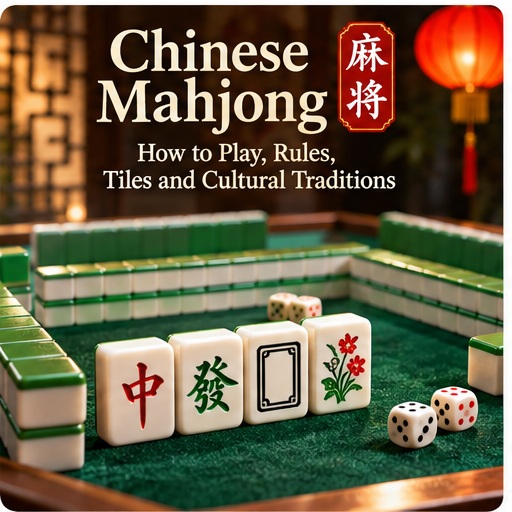
Four people sit around a square table. A player draws a tile, studies it and places another face up in the center. Someone calls “碰!” (Pèng!). The table fills with the clicking sound of tiles being shuffled, stacked and discarded. This is 麻将 (májiàng), mahjong, one of China’s most recognizable traditional games.
Mahjong combines pattern recognition, memory, probability, strategy and social interaction. Beginners may find the symbols and regional rules intimidating, but the basic structure is approachable: learn the tiles, recognize sets, understand the turn sequence and then choose a particular ruleset.
What Is Chinese Mahjong?
Mahjong is a tile-based game traditionally played by four people. Players draw and discard tiles to form a legal winning hand. In many versions, a standard hand has four sets and one pair. Sets are sequences of three consecutive suited tiles or groups of three identical tiles. Some rulesets allow special hands that do not follow this structure.
Scoring, legal claims and winning conditions vary by version. Before playing, always ask: Which version are we playing?
A Brief History of Mahjong
Mahjong developed in China during the nineteenth century, though its exact origins are debated. It is linked to earlier Chinese card and tile games. Forms of mahjong circulated in the late Qing period and spread internationally during the early twentieth century. In the United States, commercial sets and new local rules helped establish American mahjong in the 1920s.
The story that Confucius invented mahjong thousands of years ago has no credible historical support. Recognizable modern mahjong is much more recent.
How Many Tiles Are in a Mahjong Set?
Many Chinese-style sets contain 144 tiles: 108 suited tiles, 16 wind tiles, 12 dragon tiles and eight flower or season tiles. Some versions use 136 tiles without flowers and seasons. Other variants may add or change tiles. Always check which tiles your chosen ruleset uses.
The Three Suits of Mahjong
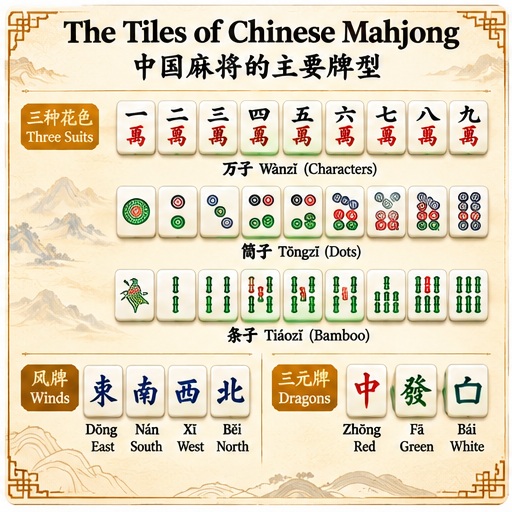
The numbered suits run from one to nine, with four copies of each tile in a standard set.
Characters — 万子 (wànzǐ): tiles with Chinese numerals and 万, meaning ten thousand. 一万, 二万 and 三万 are one, two and three characters.
Dots — 筒子 (tǒngzǐ): numbered tiles illustrated with circles, generally easy for beginners to count.
Bamboo — 条子 (tiáozǐ): numbered tiles illustrated with stylized bamboo sticks. The one-bamboo tile is often depicted as a bird rather than a stick.
Honor Tiles: Winds and Dragons
The four winds are 东 (dōng, East), 南 (nán, South), 西 (xī, West) and 北 (běi, North). Winds can influence seating, rounds and scoring.
The three dragons are 中 (zhōng, Red Dragon), 发 (fā, Green Dragon) and 白 (bái, White Dragon), which may appear as a blank or framed tile. Honor tiles cannot make ordinary numbered sequences.
Flowers and Seasons
Some sets have eight flower and season bonus tiles. In variants that use them, players commonly reveal them and draw replacements. Their scoring differs by ruleset; many beginner games omit them.
The Basic Mahjong Combinations
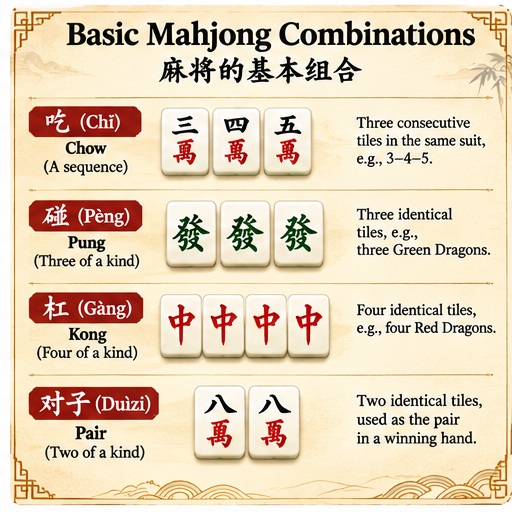
Chow — 吃 (chī): three consecutive numbers in one suit, such as 2–3–4 bamboo or 4–5–6 dots. Sequences cannot cross suits or wrap from nine to one. Honor tiles cannot form chows.
Pung — 碰 (pèng): three identical tiles, such as three 5-dot tiles or three East Winds.
Kong — 杠 (gàng): four identical tiles. A kong is treated as a set in many rules but requires special procedures, often including a replacement draw.
Pair — 将 (jiàng): two identical tiles. A standard four-sets-and-a-pair winning hand needs one pair.
What Does a Winning Mahjong Hand Look Like?
A standard example has 2–3–4 bamboo, 4–5–6 dots, 7–8–9 characters, three Red Dragons and two East Winds. These form three chows, one pung and one pair: 14 tiles total.
However, structural completeness does not guarantee a legal win in every version. Some rulesets require minimum scores, additional patterns or specific conditions.
How to Set Up a Mahjong Game
Step 1 — Choose the rules: agree on a simplified version, Hong Kong Old Style, Sichuan mahjong or Mahjong Competition Rules. Avoid mixing scoring systems.
Step 2 — Assign seats: East, South, West and North are used in many variants. East often acts as dealer.
Step 3 — Shuffle: place tiles face down and mix them thoroughly. Automatic tables can shuffle and build walls mechanically.
Step 4 — Build walls: arrange tiles in two-high rows forming a square. Length depends on the number of tiles used.
Step 5 — Deal: in many versions, the dealer starts with 14 tiles and other players with 13, and the dealer discards first. Exact procedures vary.
How a Mahjong Turn Works
The basic rhythm is draw, evaluate and discard. Players often hold 13 tiles between turns, draw a fourteenth and then discard one. Certain discarded tiles may be claimed by other players under specific conditions.
In many traditional versions, a player can claim a discard to complete a pung or kong. A chow usually requires a discard from the immediately preceding player in turn order. A discard can also be claimed to win when permitted. Competing claim priority varies.
How Do You Win at Mahjong?
Winning is commonly called 胡牌 (húpái), and a player might say 胡了! (Hú le!) — “I’ve won!” Some variants permit winning from a self-drawn tile and from another player’s discard, with different scoring. First learn to identify complete hands, then study the winning conditions and scores for your chosen ruleset.
A Simple Example of Mahjong Strategy
Suppose your hand has 2–3 bamboo, 5–6 dots, two 8-character tiles, three Red Dragons and several unrelated tiles. The Red Dragons already form a pung, and the two 8-character tiles may be your pair. A 1 or 4 bamboo can complete the first sequence; a 4 or 7 dots can complete the second.
Adjacent tiles can have several possible improvements. An isolated honor tile may be less flexible unless it serves a scoring plan or you can collect matches. Evaluate how many unseen tiles could help your hand.
Five Beginner Mahjong Strategy Tips
Keep flexible sequences: adjacent suited tiles such as 4–5 can be completed in multiple ways.
Watch other players’ discards: visible tiles help estimate what remains, although concealed hands remain unknown.
Avoid breaking useful groups too early: pairs and near-complete sequences may become important.
Learn scoring requirements: a complete-looking hand may not be enough to win.
Balance speed and safety: discarding a useful tile can also help an opponent win.
The Main Types of Mahjong
Chinese mahjong is an umbrella term, not a single nationwide casual ruleset. Regional versions differ in tiles, scoring and winning requirements.
Hong Kong Old Style: a traditional rules family often using four sets and a pair with fan-based scoring; house rules differ.
Sichuan Mahjong — 四川麻将: popular variants often use only three numbered suits without winds or dragons. Some require selecting a suit to discard. Specific rules vary locally.
Mahjong Competition Rules (MCR): a standardized competitive system with many scoring patterns and a minimum winning threshold.
American mahjong: often uses jokers, racks and an annual National Mah Jongg League card of permitted hands; not interchangeable with Chinese mahjong.
Japanese riichi mahjong: has riichi declarations, yaku requirements, dora and a distinct strategic and scoring system.
Chinese Mahjong vs. American Mahjong
Many Chinese versions use suited and honor tiles, sometimes bonus tiles, with regional scoring and commonly a four-sets-and-a-pair structure plus variant conditions.
American mahjong generally includes jokers and flowers, uses an annual card specifying winning hands, and often includes the Charleston tile-passing procedure. They are related games, not the same rulebook.
Is Mahjong a Game of Luck or Skill?
Both. The draw is uncertain and opponents’ hands are concealed. Skill affects pattern recognition, hand flexibility, tile efficiency, discard decisions and defense. Luck can dominate a single round; over repeated play, strategic decisions matter. The balance depends partly on the variant.
Is Mahjong Gambling?
Mahjong may be played casually, competitively for points, or with money involved. Betting is not required. Laws concerning money-based play differ by location. For beginners, playing without stakes is a practical way to learn.
Mahjong in Chinese Family and Social Life
Mahjong is associated with social gatherings, holidays and friendly competition in many communities, though not every Chinese person plays. The clatter of hard tiles comes from shuffling, stacking and discarding. Players may call claims aloud, joke and discuss hands between rounds.
Automatic mahjong tables shuffle and arrange tiles beneath the surface, then raise prepared walls. They save time but do not teach the rules.
Mahjong Etiquette for Beginners
Agree on the rules, scoring and house procedures before playing.
Arrange concealed tiles so opponents cannot see them.
Announce legal claims clearly and wait before touching a discard.
Avoid exposing concealed information or coaching other players unfairly.
Respect the pace of the game; experienced players should explain rules patiently.
Common Beginner Mistakes
Confusing suits: a 3-dot tile and a 3-bamboo tile do not make a pair.
Making sequences with honor tiles: East, South and West do not make a chow.
Forgetting the pair: four sets alone do not complete a standard hand.
Assuming every structurally complete hand can win: some variants require additional scoring conditions.
Mixing Japanese, American and Chinese rules without agreement.
Useful Mandarin for Playing Mahjong
麻将 — májiàng — mahjong; 麻将牌 — májiàngpái — mahjong tiles; 洗牌 — xǐpái — shuffle; 摸牌 — mōpái — draw a tile; 打牌 — dǎpái — play or discard a tile, depending on context.
吃 — chī — chow; 碰 — pèng — pung; 杠 — gàng — kong; 胡牌 — húpái — win; 自摸 — zìmō — win by self-draw.
万子 — wànzǐ — characters; 筒子 — tǒngzǐ — dots; 条子 — tiáozǐ — bamboo; 东风 — dōngfēng — East Wind; 红中 — hóngzhōng — Red Dragon; 白板 — báibǎn — White Dragon; 庄家 — zhuāngjiā — dealer; 番 — fān — scoring unit in some variants; 听牌 — tīngpái — waiting for a winning tile.
Five Useful Mahjong Phrases
你会打麻将吗? Nǐ huì dǎ májiàng ma? — Can you play mahjong?
我是新手。 Wǒ shì xīnshǒu. — I’m a beginner.
轮到谁了? Lún dào shéi le? — Whose turn is it?
我碰! Wǒ pèng! — I’m claiming a pung!
我胡了! Wǒ hú le! — I’ve won!
Frequently Asked Questions
How many people play Chinese mahjong? Traditionally four, though adaptations exist.
How many tiles are in a set? Commonly 144, or 136 without bonus tiles.
What is the goal? Form a legal winning hand under the chosen ruleset.
Is it hard to learn? The basics are accessible; scoring and strategy take practice.
Can two people play? Adaptations exist, but traditional mahjong uses four.
Chow vs. pung? A chow is three consecutive suited tiles; a pung is three identical tiles.
Pung vs. kong? A pung has three identical tiles; a kong has four and special procedures.
Can you win with seven pairs? Some rulesets recognize this special hand.
What does mahjong mean? The modern Chinese name is 麻将 (májiàng); historical explanations vary.
Is Chinese mahjong the same as Japanese mahjong? No; winning and scoring rules differ.
Can you learn without Chinese? Yes. Numbered tile sets and English guides help.
A Game That Rewards Attention
At first mahjong seems like a confusing collection of symbols. Then the patterns appear: a useful sequence, a promising pair, a discard that matters. The calls of 吃, 碰 and 胡 become meaningful decisions. Mahjong offers a game of chance, observation and strategy, but also a shared table, conversation and the familiar sound of tiles mixed for another round.
Further Reading
Mahjong Competition Rules — standardized competition scoring framework.
National Mah Jongg League — American mahjong rules and annual card information.
Historical museum collections — mahjong sets and the game’s international spread.
Regional mahjong associations and rulebooks — local variants and scoring procedures.