Chinese Zodiac Explained: The 12 Animals, Their Meanings and How to Find Your Sign
Learn the 12 Chinese zodiac animals, their order and cultural meanings, how to find your sign, and why 2027 is the Fire Goat year.
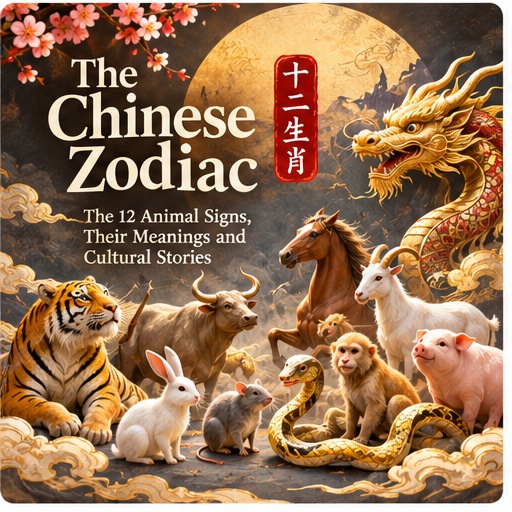
Chinese Zodiac Explained: The 12 Animals, Their Meanings and How to Find Your Sign
What animal are you? In many Chinese conversations, this question has nothing to do with pets or favorite wildlife. It refers to your Chinese zodiac sign, known as 生肖 (shēngxiào). Someone might say, “I was born in the Year of the Dragon,” or “My child is a Rabbit.” These animals appear on calendars, New Year decorations, gifts, and traditional artwork. They also provide a familiar way to talk about generations and the passing of time. But the Chinese zodiac is more complicated than simply matching a birth year to an animal. The twelve animals form a repeating cycle. Their meanings are connected with stories, symbols, and traditional ideas about time. The Chinese calendar also means that people born in January or February need to check their exact birthday. This guide explains how the system works, what the twelve animals represent, and how to find your sign without confusing folklore with scientific fact.
What Is the Chinese Zodiac?
The Chinese zodiac is a traditional system that assigns one of twelve animals to each year in a repeating cycle. In Chinese, it is commonly called 十二生肖 (shí'èr shēngxiào), meaning the twelve zodiac animals. Each animal corresponds to one of the twelve Earthly Branches (地支, dìzhī), a traditional sequence used to organize time. The zodiac is part of a larger Chinese calendrical and symbolic tradition. It is not equivalent to Western astrology's twelve signs, which are associated with different portions of the solar year. In the familiar Chinese zodiac system, the animal is associated with a year rather than a month-long period.
The 12 Chinese Zodiac Animals and Their Order
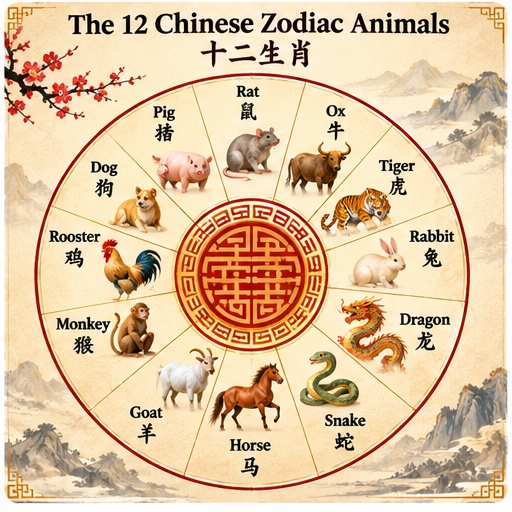
- 1. Rat — 鼠 (shǔ) — Cleverness, adaptability
- 2. Ox — 牛 (niú) — Patience, diligence
- 3. Tiger — 虎 (hǔ) — Courage, strength
- 4. Rabbit — 兔 (tù) — Gentleness, caution
- 5. Dragon — 龙 (lóng) — Power, vitality, good fortune
- 6. Snake — 蛇 (shé) — Wisdom, intuition
- 7. Horse — 马 (mǎ) — Energy, independence
- 8. Goat — 羊 (yáng) — Gentleness, harmony
- 9. Monkey — 猴 (hóu) — Ingenuity, playfulness
- 10. Rooster — 鸡 (jī) — Alertness, confidence
- 11. Dog — 狗 (gǒu) — Loyalty, sincerity
- 12. Pig — 猪 (zhū) — Generosity, abundance
These associations are part of traditional symbolism and popular interpretation. They should not be treated as scientifically established personality traits. People born in the same zodiac year can have entirely different personalities, interests, and life experiences.
Why Are the Animals in This Order?
One of the most famous explanations is a folktale called the Great Race. In a popular version, the Jade Emperor organizes a race to determine the order of the twelve zodiac animals. The Rat knows that the Ox is strong and reliable, so it rides on the Ox's back. Near the finish line, the Rat jumps ahead and arrives first. The Ox comes second. The Tiger follows in third place, while the Rabbit manages to cross the river and finish fourth. The Dragon, despite being able to fly, arrives fifth because it has stopped to help others. The remaining animals take their places, with the Pig arriving last. Different retellings explain the positions of the Snake, Horse, Goat, Monkey, Rooster, and Dog in different ways. The story is entertaining and gives children an easy way to remember the sequence. But it is important to distinguish folklore from history. The Great Race is a traditional explanatory story, not documentary evidence that the zodiac was created through an actual animal competition.
Where Did the Chinese Zodiac Come From?
The twelve zodiac animals are connected to the ancient system of Earthly Branches. The Earthly Branches were used in Chinese calendrical traditions to mark time, including years, months, days, and periods of the day. Animal associations developed historically alongside these timekeeping systems. Evidence from early Chinese texts and archaeological materials shows that animal-based calendrical correspondences existed long before the modern zodiac became a familiar feature of popular culture. However, the precise history of how the animal sequence developed is complex. It is more accurate to describe the zodiac as an evolving calendrical and cultural system than to claim that one emperor invented all twelve signs on a specific date. Over time, the animals became closely connected with birth years, festivals, visual art, folk stories, and popular beliefs about fortune. Today, many people use the zodiac primarily as a cultural symbol rather than a serious method of predicting their future.
How to Find Your Chinese Zodiac Sign
For most people, the basic rule is straightforward: find the Chinese lunar year in which you were born, then identify its animal. However, there is an important complication. The Chinese zodiac year does not normally begin on January 1. For popular birth-year zodiac identification, the boundary is commonly Chinese New Year's Day, which falls in January or February. This means that someone born in early January may belong to the previous zodiac animal. A person born in February may need to check whether their birthday falls before or after Chinese New Year.
Chinese Zodiac Years: 1996–2035
- 1996 Rat; 1997 Ox; 1998 Tiger; 1999 Rabbit; 2000 Dragon; 2001 Snake; 2002 Horse; 2003 Goat; 2004 Monkey; 2005 Rooster; 2006 Dog; 2007 Pig.
- 2008 Rat; 2009 Ox; 2010 Tiger; 2011 Rabbit; 2012 Dragon; 2013 Snake; 2014 Horse; 2015 Goat; 2016 Monkey; 2017 Rooster; 2018 Dog; 2019 Pig.
- 2020 Rat; 2021 Ox; 2022 Tiger; 2023 Rabbit; 2024 Dragon; 2025 Snake; 2026 Horse; 2027 Goat; 2028 Monkey; 2029 Rooster; 2030 Dog; 2031 Pig.
- 2032 Rat; 2033 Ox; 2034 Tiger; 2035 Rabbit.
Important: Each listed animal begins on that year's Chinese New Year's Day, not automatically on January 1. If your birthday falls in January or February, check the precise date before deciding.
Example: Born in Early 2027
Chinese New Year in 2027 falls on February 6. Under the commonly used Lunar New Year boundary, someone born on February 5, 2027, belongs to the preceding Horse year, while someone born on February 6 belongs to the Goat year. The Goat year continues until January 25, 2028. The Monkey year begins on January 26, 2028. This is why a simple calendar-year lookup can give the wrong answer.
Why Do Some Sources Use the Start of Spring Instead?
You may encounter a different boundary called 立春 (Lìchūn), the Start of Spring solar term. Some traditional Chinese astrology systems, especially certain methods of Bazi (八字) or Four Pillars analysis, use Lichun to determine the year pillar. That is not the same convention used for the popular Chinese New Year zodiac animal. For a general cultural guide, the Lunar New Year boundary is the clearest choice. For a specialized Bazi calculation, the relevant method and precise birth time matter. Neither approach should be presented as a scientific method of predicting personality or future events.
The 12 Zodiac Animals Explained
Each animal has developed a rich set of cultural associations. These meanings are not fixed rules, and interpretations can vary across regions, families, and historical periods.
1. Rat — 鼠 (Shǔ)
The Rat is first in the zodiac cycle. In the Great Race story, its cleverness allows it to finish ahead of larger animals. Rats are often associated with resourcefulness, quick thinking, and adaptability. Although rats can have negative associations in everyday life, the zodiac Rat is not simply a symbol of something undesirable.
2. Ox — 牛 (Niú)
The Ox is associated with agricultural labor, endurance, and steady effort. For centuries, cattle played an important role in farming. This gives the Ox strong associations with patience, reliability, and diligence. In the Great Race, the Ox's helpfulness allows the Rat to ride on its back.
3. Tiger — 虎 (Hǔ)
The Tiger is a powerful animal in Chinese cultural imagination. It appears in folk art, protective imagery, stories, and traditional decorative objects. The zodiac Tiger is often associated with courage, strength, and boldness. Tiger-themed clothing and accessories for children can carry protective or auspicious meanings in some traditions.
4. Rabbit — 兔 (Tù)
The Rabbit is commonly associated with gentleness, alertness, and careful behavior. It also has a special place in Chinese lunar mythology. The Jade Rabbit (玉兔, yùtù) is associated with the moon and appears in stories connected to the moon goddess Chang'e. This gives the Rabbit a cultural presence beyond the zodiac.
5. Dragon — 龙 (Lóng)
The Dragon is the only mythical creature in the standard twelve-animal sequence. In Chinese culture, dragons have often been associated with power, vitality, rain, water, and auspicious influence. They also became closely connected with imperial symbolism. The Chinese dragon should not be treated as identical to the fire-breathing dragons familiar from many European fantasy traditions. Dragon years are often culturally prominent, and some families view them as particularly auspicious.
6. Snake — 蛇 (Shé)
The Snake is associated in popular zodiac interpretations with wisdom, intuition, and careful observation. Snakes also appear in Chinese mythology and literature. One famous example is the Legend of the White Snake (白蛇传), which tells a story of love, transformation, and conflict. The snake's cultural meanings are diverse and cannot be reduced to a single personality description.
7. Horse — 马 (Mǎ)
Horses have long been important in transportation, warfare, communication, and art. They are associated with movement, energy, and freedom. A familiar Chinese expression is 马到成功 (mǎ dào chéng gōng), meaning to achieve immediate success. The Horse is the zodiac animal associated with the lunar year beginning February 17, 2026.
8. Goat — 羊 (Yáng)
The eighth animal is written 羊 (yáng). This Chinese word can refer broadly to sheep and goats, which explains why English sources use Goat, Sheep, or sometimes Ram. These are translations of the same zodiac animal, not three different signs. In traditional interpretations, the Goat is associated with gentleness, harmony, and artistic sensitivity. The lunar year beginning February 6, 2027, is a Goat year.
9. Monkey — 猴 (Hóu)
The Monkey is commonly associated with cleverness, playfulness, and adaptability. Monkeys also have an important place in Chinese literature. The most famous example is Sun Wukong (孙悟空), the Monkey King from Journey to the West. Sun Wukong is not simply a zodiac mascot, but his popularity adds another layer to the monkey's cultural image.
10. Rooster — 鸡 (Jī)
The Rooster is associated with the arrival of morning, alertness, and confidence. Its crowing marks the beginning of a new day. Roosters appear in traditional paintings, paper cutting, and decorative arts. In some popular interpretations, the zodiac Rooster symbolizes order and diligence.
11. Dog — 狗 (Gǒu)
Dogs are widely associated with loyalty and companionship. These associations also appear in popular zodiac descriptions. The zodiac Dog may be portrayed as sincere, dependable, and protective. As with every sign, these are traditional symbolic qualities rather than proven traits of people born in a Dog year.
12. Pig — 猪 (Zhū)
The Pig completes the twelve-animal cycle. In Chinese agricultural life, pigs have long been connected with household livelihood and food production. The zodiac Pig is often associated with abundance, generosity, and contentment. Its last-place finish in the Great Race is sometimes explained through humorous stories about eating or sleeping along the way.
What Are the Five Elements of the Chinese Zodiac?
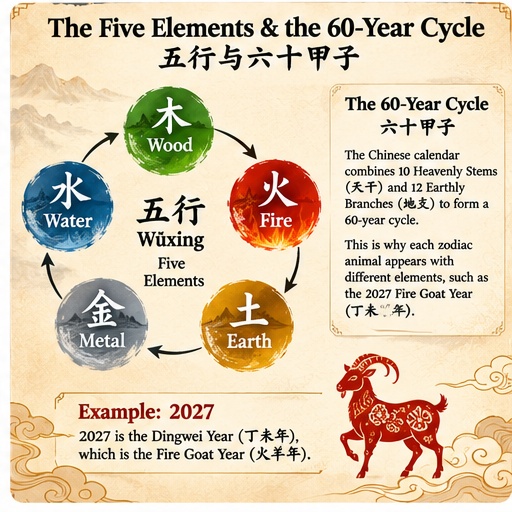
The twelve animals are only part of the traditional calendrical system. Another important framework is 五行 (wǔxíng), commonly translated as the Five Elements or Five Phases. They are Wood — 木 (mù); Fire — 火 (huǒ); Earth — 土 (tǔ); Metal — 金 (jīn); and Water — 水 (shuǐ). These categories describe traditional patterns of relationship and transformation. They should not be confused with the chemical elements of modern science. When combined with the twelve Earthly Branches through the traditional Heavenly Stems and Earthly Branches system, they form a repeating 60-year cycle. This is why two Goat years can have different element designations.
Why Is 2027 the Fire Goat Year?
The traditional year designation for 2027 is 丁未 (Dīngwèi). 丁 (Dīng) is associated with Yin Fire in the Heavenly Stems system. 未 (Wèi) is the Earthly Branch corresponding to the Goat. Together, they form the Fire Goat year. The same stem-and-branch combination last occurred in 1967 and will recur in 2087. The 60-year cycle is a calendrical structure. Popular claims about the specific personality or fortune of people born in a Fire Goat year are cultural interpretations, not established scientific findings.
What Is Benmingnian, Your Zodiac Year?
A familiar Chinese expression is 本命年 (běnmìngnián). It refers to a year when your zodiac animal returns. Because the animal cycle repeats every twelve years, a person's zodiac year commonly returns around ages 12, 24, 36, 48, and so on. In some folk traditions, benmingnian is regarded as a year requiring extra caution. People may wear red socks, belts, bracelets, or other red accessories for good fortune. However, this is not a universal practice. Some people observe it seriously, others enjoy it as a family custom, and many do not attach special significance to it. The belief should be understood as part of cultural tradition rather than evidence that a particular age is inherently unlucky.
Are Chinese Zodiac Signs Compatible?
You may see charts claiming that some zodiac animals are ideal romantic partners while others are incompatible. These ideas come from traditional symbolic systems and later popular interpretations. They are common in entertainment, fortune-telling, and conversations about relationships. But there is no reliable scientific evidence that a person's birth-year animal determines relationship success. Compatibility depends on factors such as communication, shared values, behavior, and circumstances. If you encounter zodiac compatibility traditions, it is best to understand them as cultural beliefs rather than rules for choosing a partner.
Chinese Zodiac vs. Western Zodiac: What's the Difference?
Both systems use twelve familiar signs, but they organize time differently. The Chinese zodiac uses twelve animals associated with a repeating year cycle, connected with the Chinese calendrical tradition and Earthly Branches. A popular sign is usually determined by the lunar birth year, and the system also includes the Five Phases and 60-year cycle. Western zodiac signs are associated with portions of the solar year and different astrological correspondences. Neither system provides a scientifically validated way to determine someone's personality or predict life events. Their cultural histories, however, are rich and worth understanding.
How the Chinese Zodiac Appears in Everyday Life
The zodiac is not limited to astrology books. It appears in familiar aspects of Chinese culture.
Chinese New Year Decorations
Each New Year brings decorations featuring the incoming animal. During a Goat year, for example, you may see goat illustrations on red envelopes, lanterns, calendars, and shopping displays.
Gifts and Souvenirs
Zodiac animals appear on jewelry, toys, stamps, ceramics, and other gifts. A gift featuring someone's birth-year animal can be a personal cultural reference.
Traditional Paper Cutting
The twelve animals are popular subjects in 剪纸 (jiǎnzhǐ), Chinese paper cutting. Their recognizable shapes make them useful for festive window decorations.
Family Conversations
People may ask 你属什么? (Nǐ shǔ shénme?), meaning “What is your Chinese zodiac animal?” This can be a friendly cultural question. However, because the answer can reveal someone's approximate age, it is considerate not to insist if a person prefers not to answer.
Is the Chinese Zodiac Used Only in China?
No. Animal-year traditions and related calendrical systems have influenced or developed across several East and Southeast Asian cultures. However, the animal lists and cultural meanings are not identical everywhere. For example, the Vietnamese zodiac commonly uses the Cat where the Chinese zodiac uses the Rabbit. Some other regional traditions have additional differences. These variations show how shared historical influences can develop into distinct local traditions. It would be inaccurate to assume that every country celebrating a lunar or lunisolar New Year uses the exact same twelve animals.
Useful Mandarin for Talking About the Zodiac
- 生肖 (shēngxiào) — Zodiac animal
- 十二生肖 (shí'èr shēngxiào) — Twelve zodiac animals
- 属 (shǔ) — To belong to a zodiac sign
- 鼠 (shǔ) — Rat
- 牛 (niú) — Ox
- 虎 (hǔ) — Tiger
- 兔 (tù) — Rabbit
- 龙 (lóng) — Dragon
- 蛇 (shé) — Snake
- 马 (mǎ) — Horse
- 羊 (yáng) — Goat / Sheep
- 猴 (hóu) — Monkey
- 鸡 (jī) — Rooster
- 狗 (gǒu) — Dog
- 猪 (zhū) — Pig
- 本命年 (běnmìngnián) — One's zodiac year
- 五行 (wǔxíng) — Five Phases
- 农历 (nónglì) — Traditional Chinese calendar
Five Useful Sentences
- 你属什么? (Nǐ shǔ shénme?) — What is your Chinese zodiac animal?
- 我属龙。 (Wǒ shǔ lóng.) — I was born in the Year of the Dragon.
- 今年是什么生肖? (Jīnnián shì shénme shēngxiào?) — What is this year's zodiac animal?
- 明年是羊年。 (Míngnián shì Yángnián.) — Next year is the Year of the Goat.
- 今年是我的本命年。 (Jīnnián shì wǒ de běnmìngnián.) — This year is my zodiac year.
Frequently Asked Questions
What are the 12 Chinese zodiac animals in order?
Rat, Ox, Tiger, Rabbit, Dragon, Snake, Horse, Goat, Monkey, Rooster, Dog, and Pig.
What Chinese zodiac animal is 2027?
2027 is the Year of the Goat, beginning February 6, 2027. It is also called the Fire Goat year.
Is 2027 the Year of the Goat or Sheep?
Both translations are used. The Chinese character 羊 (yáng) can refer broadly to goats and sheep. Ram is another translation sometimes used in English.
How do I find my Chinese zodiac sign?
Find the Chinese lunar year containing your birthday. If you were born in January or February, check the exact date of Chinese New Year.
Does the Chinese zodiac change on January 1?
No. Under the common popular convention, the animal changes on Chinese New Year's Day.
Why do some zodiac calculators disagree?
Some use Chinese New Year as the boundary, while certain traditional astrology methods use Lichun, the Start of Spring solar term. Calculators may also handle birth dates incorrectly.
What is the luckiest Chinese zodiac animal?
There is no objectively luckiest animal. Dragons are often considered especially auspicious in popular culture, but beliefs vary.
What is the difference between a zodiac animal and an element?
The animal belongs to the twelve-year Earthly Branch cycle. The element designation comes from the associated Heavenly Stem, forming part of the 60-year cycle.
Does the Chinese zodiac predict personality?
No scientific evidence establishes that birth-year animals determine personality. Zodiac descriptions are best understood as cultural symbolism and entertainment.
Why is the Dragon the only mythical animal?
The standard zodiac sequence includes eleven animals familiar from the natural world and the culturally important Chinese dragon. The historical development of the sequence is complex; there is no single proven explanation for every choice.
Twelve Animals, One Continuing Tradition
The Chinese zodiac is easy to remember because it tells time through animals. But its enduring appeal goes beyond memorizing a sequence. The Rat recalls a clever folktale. The Ox evokes generations of agricultural work. The Tiger appears in protective folk imagery. The Rabbit connects to moon legends. The Dragon expresses a distinctive Chinese cultural imagination. Each animal carries stories that people continue to retell, reinterpret, and share. The zodiac does not need to predict your future to be meaningful. It offers a way to understand how people have organized time, expressed hopes, and connected individual lives to a repeating calendar. And every twelve years, the cycle begins again.
Further Reading
- Hong Kong Observatory — Chinese Calendar and Gregorian–Lunar Calendar Conversion Tables.
- Encyclopaedia Britannica — Chinese zodiac and traditional Chinese calendar.
- The Metropolitan Museum of Art — resources on Chinese animals, symbolism, and decorative arts.
- UNESCO Intangible Cultural Heritage — Spring Festival traditions and their contemporary cultural context.