Chinese Tea Culture Explained: Six Types of Tea, Gongfu Brewing and Tea Etiquette
Explore Chinese tea culture, six tea types, gongfu brewing, gaiwan techniques, regional customs, tea etiquette, and useful Mandarin for a teahouse visit.
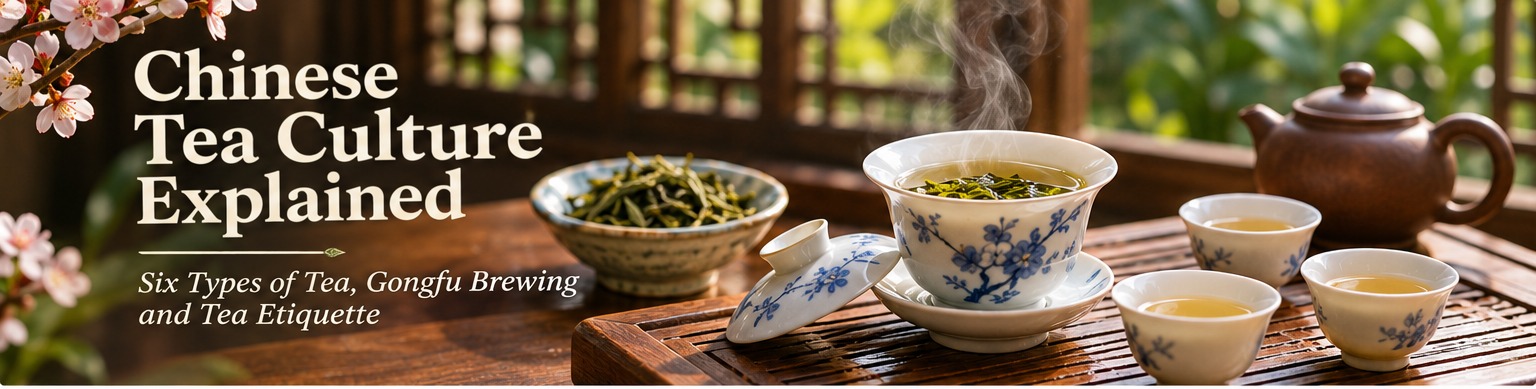
Imagine visiting a friend in China. Before you finish taking off your coat, your host brings out hot tea. Perhaps the leaves float in a glass; perhaps a small teapot sits beside tiny cups. Nobody announces a ceremony. You talk, drink, and refill the cups. In another setting, a tea maker warms a covered bowl and prepares several short infusions. Both experiences belong to Chinese tea culture (中国茶文化, Zhōngguó chá wénhuà).
Tea is an everyday drink, an agricultural craft, a social custom, and sometimes a carefully practiced art. To understand it, look beyond elaborate ceremonies to the people and places that shaped it.
What Makes Chinese Tea Culture Special?
China has many ways to grow, process, serve and appreciate tea. A Beijing family may drink jasmine tea from a mug; a Hangzhou resident may use a glass for green tea; friends in Guangdong may share small cups of oolong; and a Chengdu teahouse may be lively with conversation. There is no single ceremony that everyone follows.
In 2022, UNESCO inscribed Traditional Tea Processing Techniques and Associated Social Practices in China on its Representative List of the Intangible Cultural Heritage of Humanity. The recognition includes cultivation, harvesting, processing, drinking, and the transmission of knowledge—not just tea ceremonies.
A Brief History of Tea in China
A famous legend credits Shennong (神农, Shénnóng) with discovering tea when leaves fell into boiling water. It is a story, not a documented account of a single inventor. Tea use evolved over a long period.
During the Tang dynasty (618–907), Lu Yu (陆羽, Lù Yǔ) wrote The Classic of Tea (茶经, Chájīng), an influential account of cultivation, utensils and preparation. In some Song-dynasty settings, powdered tea was whisked in bowls. Loose-leaf steeping became increasingly prominent during the Ming dynasty, helping shape the teapots and infusion methods familiar today.
Tea traveled through trade, migration and cultural exchange. Japanese chanoyu, British afternoon tea and Chinese gongfu brewing have distinct histories; none should be treated as an interchangeable version of another.
The Six Types of Chinese Tea
Traditional tea generally comes from Camellia sinensis. The six categories are distinguished mainly by processing—not simply leaf color or origin. Cultivar, climate, harvest and craftsmanship also affect flavor.
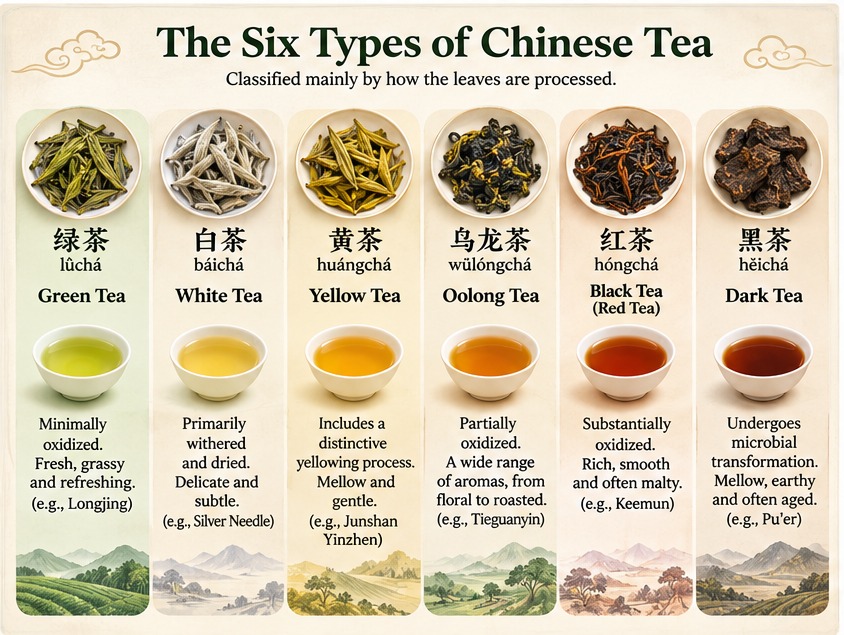
1. Green Tea — 绿茶 (Lǜchá)
Heat treatment limits enzymatic oxidation, preserving fresh flavors that can be grassy, nutty or lightly toasted. Longjing (龙井, Lóngjǐng), associated with Hangzhou, is known for flat leaves and chestnut-like notes. Biluochun (碧螺春, Bìluóchūn) is a curled green tea associated with the Lake Tai region. Delicate greens can turn bitter with overly hot water or long steeping.
2. White Tea — 白茶 (Báichá)
White tea is primarily withered and dried. It can be delicate, floral, fruity or honey-like; the infusion is not literally white. Fujian is associated with Baihao Yinzhen (白毫银针, Silver Needle), made from buds, and Bai Mudan (白牡丹, White Peony), which includes buds and leaves.
3. Yellow Tea — 黄茶 (Huángchá)
Yellow tea involves a distinctive controlled yellowing stage, often called menhuang (闷黄). The resulting taste may be mellow and less sharply vegetal than some greens. Junshan Yinzhen (君山银针), associated with Hunan, is a notable example. Genuine yellow tea is comparatively specialized.
4. Oolong Tea — 乌龙茶 (Wūlóngchá)
Oolongs are partially oxidized and span a broad spectrum, from floral and bright to roasted and mineral. Tieguanyin (铁观音) is associated with Anxi, Fujian; Da Hong Pao (大红袍) with the Wuyi Mountains. Oolong often rewards multiple short infusions because its aroma and taste develop across rounds.
5. Black Tea — 红茶 (Hóngchá)
A crucial translation: English “black tea” is normally 红茶 (hóngchá), literally “red tea,” in Chinese. These substantially oxidized teas can be malty, fruity or floral. Examples include Qimen Hongcha (祁门红茶, Keemun) from Anhui and Dianhong (滇红) from Yunnan.
6. Dark Tea — 黑茶 (Hēichá)
Dark tea undergoes microbial transformation during processing or aging. Pu’er (普洱茶) from Yunnan is a familiar example. Sheng (raw) Pu’er changes gradually under suitable storage; shou (ripe) Pu’er undergoes an accelerated pile-fermentation process. Pu’er classification has regional and technical nuances, so a simple chart cannot capture every distinction.
Where Does Jasmine Tea Fit?
Jasmine tea (茉莉花茶, mòlì huāchá) is a scented tea, commonly produced by transferring jasmine fragrance to processed tea leaves, often green tea. It is popular but is not a seventh basic processing category.
What Is Gongfu Tea?
Gongfu tea (工夫茶 or 功夫茶, gōngfu chá) emphasizes skill and attention: relatively generous leaf quantities, small vessels, and repeated short infusions. It is particularly associated with parts of Guangdong and Fujian but is now enjoyed much more widely. A casual session can be as meaningful as a formal demonstration; there is no single mandatory choreography.
The Essential Tea Tools
- 盖碗 (gàiwǎn) — a lidded bowl for brewing or drinking tea; porcelain is versatile.
- 茶壶 (cháhú) — a teapot, sometimes small for repeated infusions.
- 公道杯 (gōngdàobēi) — a sharing pitcher that evens out infusion strength.
- 茶杯 (chábēi) — a cup, often small in gongfu brewing.
- 茶盘 (chápán) — a tray that holds teaware and may collect water.
How to Brew Chinese Tea at Home
You do not need expensive teaware. For simple cup brewing, try 2–3 grams of loose tea in a 250 ml cup. Add appropriately heated water, taste after roughly 1–3 minutes, and refill as needed. For delicate green tea, begin around 75–85°C rather than using vigorously boiling water. Adjust according to the leaves and your taste.
Beginner Gongfu Brewing with a Gaiwan
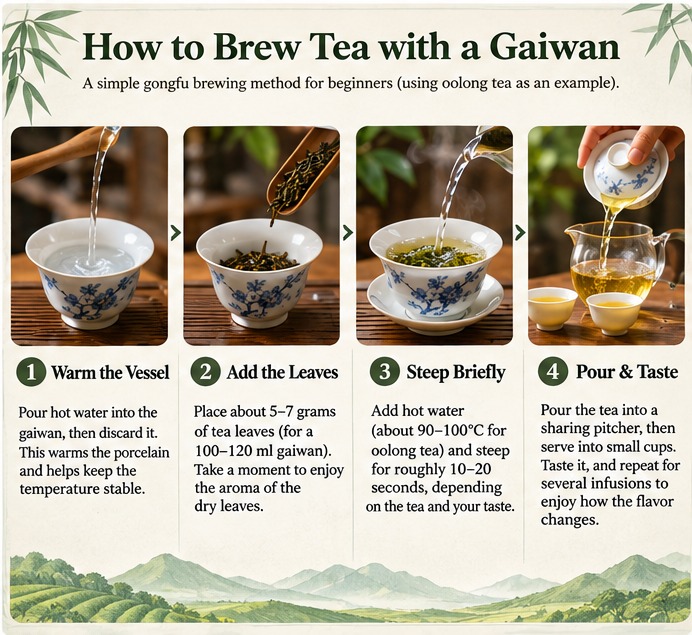
- Warm the vessel: rinse an empty 100–120 ml gaiwan with hot water, then discard the water carefully.
- Add leaves: start with about 5–7 grams of oolong; notice the dry aroma.
- Steep briefly: for many roasted oolongs, start around 90–100°C and 10–20 seconds, adjusting for the tea.
- Pour and taste: decant completely into a sharing pitcher or cups, then repeat infusions and notice how flavors change.
Some drinkers briefly rinse certain oolongs or compressed teas; others do not. A rinse is optional and does not guarantee the removal of contaminants. Brewing times and temperatures are starting points, not universal rules.
Chinese Tea Etiquette: What Visitors Should Know
A polite thank-you is usually enough when someone offers tea. Hosts often serve guests before themselves, but serving order differs by household and region. A refill is generally hospitality rather than pressure to drink quickly.
In some southern Chinese and Cantonese settings, light finger tapping on the table expresses thanks for poured tea. This is called 叩指礼 (kòu zhǐ lǐ). A popular origin story involving the Qianlong Emperor is folklore, not established historical fact. It is not a rule everywhere in China.
Tea may also express respect at family occasions and weddings, though ceremonies differ. Watch what your hosts do rather than assuming all Chinese families follow the same ritual.
What Happens in a Chinese Teahouse?
A teahouse may be a relaxed place to talk, play games, work or enjoy a tasting. Chengdu is especially known for sociable teahouses with bamboo chairs and covered bowls. Before ordering, ask whether pricing is per person, pot or tea selection, and whether seating or service is charged separately.
For a first visit, choose Longjing if you enjoy fresh green flavors, jasmine tea for floral aroma, Tieguanyin for a fragrant oolong, Wuyi oolong for roasted notes, or Dianhong for a richer black tea. A modestly priced tea you enjoy is better than an expensive tea chosen only for prestige.
Chinese Tea and Japanese Tea Ceremony
Chinese tea traditions include everything from informal glass brewing to structured gongfu sessions. Japanese chanoyu developed distinct practices and aesthetics around preparing powdered matcha. Their histories connect through cultural exchange, but each deserves to be understood on its own terms.
Is Chinese Tea Healthy?
Tea contains caffeine and polyphenols, but it is not a cure for disease. Research into health effects varies in quality and cannot justify sweeping promises. Caffeine levels depend on the tea, amount of leaves and brewing method; white tea is not automatically lower in caffeine than black tea. People sensitive to caffeine may prefer smaller servings or earlier drinking times.
Useful Mandarin for Drinking and Buying Tea
- 茶 (chá) — tea
- 茶叶 (cháyè) — tea leaves
- 绿茶 (lǜchá) — green tea
- 红茶 (hóngchá) — black tea
- 乌龙茶 (wūlóngchá) — oolong
- 普洱茶 (pǔ’ěrchá) — Pu’er tea
- 茉莉花茶 (mòlì huāchá) — jasmine tea
- 盖碗 (gàiwǎn) — covered bowl
- 泡茶 (pào chá) — brew tea
- 续水 (xù shuǐ) — refill water
- 有点苦 (yǒudiǎn kǔ) — a little bitter
- 很香 (hěn xiāng) — very fragrant
你们有什么茶? Nǐmen yǒu shénme chá? — What kinds of tea do you have?
我想喝一杯绿茶。 Wǒ xiǎng hē yì bēi lǜchá. — I’d like a cup of green tea.
可以再加一点热水吗? Kěyǐ zài jiā yìdiǎn rèshuǐ ma? — Could you add a little more hot water?
这个茶有点苦。 Zhège chá yǒudiǎn kǔ. — This tea is a little bitter.
这个茶闻起来很香。 Zhège chá wén qǐlái hěn xiāng. — This tea smells wonderful.
Frequently Asked Questions
What are the six types? Green, white, yellow, oolong, black and dark tea. Chinese 红茶 (red tea) is English black tea, while 黑茶 is dark tea.
What is gongfu tea? A style of repeated short infusions using small vessels and relatively generous amounts of leaves.
Do Chinese people add milk? Traditional loose-leaf tea is often served plain, but milk tea and bubble tea are also popular in contemporary settings.
Must I perform a ceremony? No. Brewing loose leaves in a glass or mug is common and entirely authentic.
Can leaves be reused? Many can be infused repeatedly; how many times depends on the tea and brewing method.
What does finger tapping mean? In some southern tea settings it is a quiet way of thanking the person who pours tea.
More Than a Cup of Tea
Chinese tea culture is not limited to perfect gestures or expensive teapots. It lives in a grandparent’s glass of green tea, a lively teahouse, the knowledge of a tea maker, and the conversations shared over small cups. Start with a tea you enjoy, learn where it comes from, and notice how it changes with each infusion. Sometimes understanding a culture begins with sharing a cup.
Further Reading
- UNESCO — Traditional Tea Processing Techniques and Associated Social Practices in China (2022).
- ISO 20715:2023 — Tea: Classification of Tea Types.
- Lu Yu — The Classic of Tea (茶经), Tang dynasty.