Chinese New Year Explained: 2027 Dates, Traditions, Food, Red Envelopes and the Spring Festival
Discover the meaning of Chinese New Year, from the 2027 dates and reunion dinners to red envelopes, traditional foods and useful Mandarin.
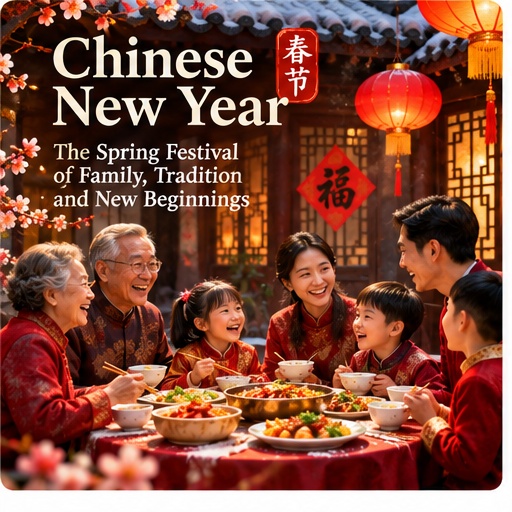
Chinese New Year Explained: 2027 Dates, Traditions, Food, Red Envelopes and the Spring Festival
Imagine arriving in a Chinese city a few days before the New Year. Red lanterns hang outside shops. Supermarkets are crowded with families buying food and gifts. Train stations fill with travelers carrying suitcases and presents for relatives they may not have seen for months. Homes are cleaned, reunion dinners planned, and children look forward to red envelopes. This is Chinese New Year, known in Chinese as 春节 (Chūnjié), the Spring Festival. It is one of China's most important cultural celebrations, bringing together family, food, memories, and hopes for a fresh beginning. To understand it, follow its traditions from the days of preparation through the first full moon of the new year.
When Is Chinese New Year in 2027?
Chinese New Year in 2027 falls on Saturday, February 6. It begins the Year of the Goat (羊年, Yángnián), specifically the Fire Goat year (丁未年, Dīngwèi Nián) in the traditional 60-year cycle. Chinese New Year's Eve (除夕) falls on February 5. The Lantern Festival (元宵节) falls on February 20. Little New Year (小年), observed on different days in different places, commonly falls on January 30 in northern China and January 31 in southern China. The cultural festival period should not be confused with the precise number of government-designated public holidays, which depends on official annual arrangements.
Why Does the Date of Chinese New Year Change?
Chinese New Year does not fall on January 1 because its date is determined by the traditional Chinese calendar rather than the Gregorian calendar. The Chinese calendar is lunisolar: it uses the phases of the moon to organize months while also accounting for the solar year and seasonal changes. The first day of the first lunar month normally falls between late January and February. The calendar sometimes includes a leap month to keep lunar months aligned with the seasons. Calling the celebration “Lunar New Year” is common in English, but the traditional Chinese calendar is more precisely described as lunisolar.
Chinese New Year vs. Lunar New Year
Chinese New Year refers specifically to the Chinese Spring Festival and its cultural traditions. Lunar New Year is a broader expression used for New Year celebrations in several Asian communities, including Vietnamese Tết and Korean Seollal. These celebrations share some calendrical features, but their food, rituals, stories, and social customs are not identical. Using the appropriate name shows respect for those differences.
Why Is It Called the Spring Festival?
The Chinese name 春节 (Chūnjié) literally means “Spring Festival.” This may seem strange to visitors who experience the holiday during freezing winter weather. The name reflects the traditional seasonal calendar, in which the New Year is associated with renewal and the approach of spring. It does not mean warm weather has necessarily arrived. The festival is also called 过年 (guònián), meaning to celebrate or pass into the new year. For many families, the most important part is the opportunity to return home and begin another year together.
The History of Chinese New Year
Chinese New Year developed over a long period from seasonal observances, agricultural rhythms, ancestor remembrance, household rituals, and traditions of welcoming a new year. Its present-day form reflects centuries of cultural change. It would be misleading to assign the entire festival to one legendary founder or a single date in ancient history. Different dynasties and communities observed New Year rituals in different ways. Over time, family reunions, festive meals, greetings, decorations, and seasonal performances became closely associated with the holiday. In 2024, UNESCO inscribed the Spring Festival's social practices on the Representative List of the Intangible Cultural Heritage of Humanity. The recognition emphasizes a living tradition sustained by families and communities, not merely spectacular public events.
The Legend of Nian: Why Red and Firecrackers?
One popular Chinese New Year story concerns a creature called 年 (Nián). According to familiar versions, Nian appeared around the New Year and frightened villagers. People discovered that the creature feared loud noises, bright lights, and the color red. They used red decorations, fire, and loud sounds to drive it away. The story provides a memorable explanation for some festive customs. However, it is a folktale, not documented proof that every Chinese New Year tradition originated from a monster. Red decorations, firecrackers, and household rituals have histories more complex than any single legend. The story remains valuable as part of the festival's storytelling tradition.
How Chinese Families Prepare for New Year
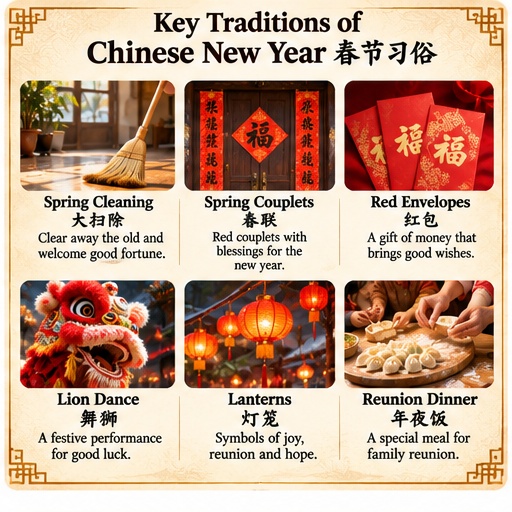
The celebration often begins well before New Year's Day. Preparations vary by region, family, and personal circumstances.
Spring Cleaning — 大扫除
Families traditionally clean their homes before the New Year. The practice is often understood symbolically as clearing away the old and preparing to welcome good fortune. People may wash windows, organize rooms, discard unwanted items, and prepare the house for visiting relatives. You may hear that cleaning or sweeping on New Year's Day could sweep away good luck. Such beliefs vary by family and region; they are customs, not rules followed by everyone.
New Year Shopping — 办年货
办年货 (bàn niánhuò) means shopping for New Year supplies. Families buy food, drinks, snacks, gifts, decorations, and ingredients for festive meals. In some homes, preparations are elaborate. In others, they are as simple as buying a few favorite foods and arranging a family dinner.
Spring Couplets — 春联
Red paper couplets are commonly placed on either side of a doorway. These 春联 (chūnlián) express wishes for happiness, prosperity, peace, or success. A shorter horizontal inscription may appear above the door. The characters are traditionally written with a brush, connecting the holiday to the art of Chinese calligraphy.
The Character Fu — 福
The character 福 (fú) represents good fortune or blessings. It appears on red decorations, doors, windows, and festive gifts. Some people display the character upside down because 倒 (dào), meaning “upside down,” sounds like 到 (dào), meaning “arrive.” The playful expression 福到了 (fú dào le) suggests that good fortune has arrived. Not every family follows the same placement convention, and some traditional settings favor displaying the character upright.
Chinese New Year's Eve: The Reunion Dinner
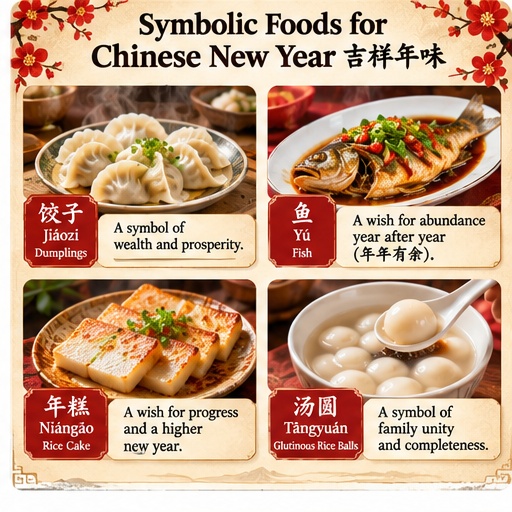
For many Chinese families, 除夕 (Chúxī), New Year's Eve, is the emotional center of the celebration. The evening meal is called 年夜饭 (niányèfàn) or 团圆饭 (tuányuánfàn), the reunion dinner. Family members may travel long distances to attend. The meal is not necessarily formal, but it carries meaning beyond the food. It is a moment to reconnect with parents, grandparents, siblings, and children. Some families prepare everything at home. Others book a restaurant or order prepared dishes. The menu varies considerably across regions and households.
Why Do People Eat Fish?
Fish is pronounced 鱼 (yú) in Mandarin. This sounds like 余 (yú), meaning surplus or something left over. The phrase 年年有余 (niánnián yǒu yú) expresses a wish for abundance year after year. Serving fish at New Year is therefore associated with prosperity. Exactly how it is prepared or served depends on local and family traditions.
Why Are Dumplings Popular?
In many northern Chinese families, dumplings, or 饺子 (jiǎozi), are a classic New Year food. Their shape is sometimes compared with historical silver ingots, creating an association with wealth. Families may gather to prepare dumplings together. But it would be inaccurate to say that everyone in China eats dumplings for New Year. Southern families may favor rice cakes, tangyuan, regional dishes, or entirely different family specialties.
Rice Cakes — 年糕
年糕 (niángāo) are glutinous rice cakes prepared in different regional styles. The word 糕 (gāo) sounds like 高 (gāo), meaning high or higher. This creates a wordplay suggesting progress and improvement in the coming year. Some versions are sweet, while others are savory.
Tangyuan — 汤圆
汤圆 (tāngyuán) are glutinous rice balls, often served in a sweet soup. Their round shape is associated with family unity and completeness. They are especially prominent during the Lantern Festival, though they may also appear at other New Year gatherings.
Red Envelopes: What Is Hongbao?
One of the best-known traditions is giving 红包 (hóngbāo), red envelopes containing money. Parents, grandparents, and other older relatives commonly give red envelopes to children or younger family members. In some workplaces and social settings, red envelopes may also be exchanged in other ways. The money is not simply a payment or reward. The gift expresses blessings and good wishes for the new year.
How Much Money Should You Put in a Red Envelope?
There is no universal amount. It depends on the relationship, local customs, family finances, and the giver's preferences. Some people choose amounts containing the number eight because 八 (bā) is popularly associated with prosperity through wordplay. The number four is sometimes avoided because 四 (sì) resembles 死 (sǐ), meaning death, in pronunciation. These are cultural associations, not requirements. A thoughtful amount appropriate to your circumstances is more important than trying to follow a rigid numerical rule.
Digital Red Envelopes
Today, red envelopes are also sent through mobile apps. A digital 红包 may be exchanged among relatives, friends, or group chats. The technology has changed, but the underlying idea of sending a New Year greeting remains familiar.
Lion Dances, Dragon Dances and Fireworks
Public celebrations may feature colorful performances. A lion dance, 舞狮 (wǔshī), is performed by people operating a lion costume, usually accompanied by drums and cymbals. The movements may be playful, acrobatic, or ceremonial. A dragon dance, 舞龙 (wǔlóng), involves multiple performers carrying a long dragon figure on poles. The dragon moves in waves and curves, often to energetic percussion. The lion and dragon dances are distinct traditions, although both can appear at New Year festivities. Firecrackers are associated with festive sound, celebration, and traditions of driving away misfortune. However, their use is restricted or prohibited in many urban areas for safety, pollution, and fire-prevention reasons. Visitors should check local regulations rather than assuming fireworks are permitted.
What Happens During the First Fifteen Days?
The festival does not consist of fifteen identical days. Traditions vary by region, but several occasions are especially recognizable.
New Year's Day — 初一
The first day often involves greetings, family visits, festive clothing, and time spent together. Some families follow customs about what to eat, whom to visit, or which activities to avoid.
Visiting Relatives — 拜年
拜年 (bàinián) means paying New Year visits or offering greetings. People visit relatives, friends, and elders, sometimes bringing gifts. Today, greetings are also exchanged through messages, calls, and video chats.
The Fifth Day — 初五
In some traditions, the fifth day is associated with welcoming the God of Wealth and resuming business activities. Practices vary, and many people do not observe a specific fifth-day ritual.
Lantern Festival — 元宵节
The fifteenth day is the Lantern Festival (元宵节, Yuánxiāo Jié). Communities may display lanterns, organize performances, and hold lantern-riddle activities. Families may eat tangyuan or yuanxiao, related glutinous-rice-ball foods with regional differences in preparation. In 2027, the Lantern Festival falls on February 20.
Is Chinese New Year Celebrated the Same Way Everywhere?
No. China has enormous regional diversity, and New Year customs differ across provinces, cities, ethnic communities, and families. A northern household may make dumplings together. A southern household may prepare rice cakes or a large meal centered on regional specialties. Some families visit temples or participate in ancestral rituals. Others focus almost entirely on family gatherings. In modern cities, people may travel, watch films, attend public events, or simply rest. There is no single celebration that represents every Chinese family.
Chinese New Year Outside China
Chinese communities around the world celebrate Spring Festival in many forms. Cities with established Chinese communities may organize parades, lion dances, markets, and cultural performances. Local traditions often reflect the histories of the communities involved. A celebration in Singapore, San Francisco, or London may therefore look different from one in Beijing or a rural Chinese village.
What Is Chunyun, the Spring Festival Travel Rush?
The period surrounding Chinese New Year is associated with 春运 (chūnyùn), the Spring Festival travel season. Millions of people travel to visit family, return to their hometowns, or take holidays. Trains, airports, and highways can become extremely busy. For many people, the journey home is a central part of the New Year experience. If you plan to travel in China around Spring Festival, arrange transport and accommodation early. Also check opening hours: some small businesses close temporarily, while tourist attractions and major commercial areas may remain busy. Exact holiday schedules should always be verified for the relevant year and location.
How Can Foreign Visitors Celebrate Respectfully?
You do not need to understand every custom to participate. If you are invited to a family meal, ask your host whether you should bring anything. Fruit, snacks, or an appropriate small gift may be welcome, but preferences vary. Learn a simple greeting, be curious about family traditions, and avoid treating every custom as a superstition that all Chinese people believe. If someone offers you a red envelope or festive food, follow your host's lead. For public celebrations, observe photography rules and respect performers and religious spaces. Most importantly, remember that Spring Festival is a living family holiday, not just a tourist spectacle.
Useful Mandarin for Chinese New Year
- 春节 (Chūnjié) — Spring Festival
- 过年 (guònián) — Celebrate the New Year
- 除夕 (Chúxī) — New Year's Eve
- 年夜饭 (niányèfàn) — Reunion dinner
- 团圆 (tuányuán) — Reunion
- 红包 (hóngbāo) — Red envelope
- 春联 (chūnlián) — Spring couplets
- 福 (fú) — Good fortune
- 拜年 (bàinián) — Offer New Year greetings
- 饺子 (jiǎozi) — Dumplings
- 年糕 (niángāo) — Rice cake
- 元宵节 (Yuánxiāo Jié) — Lantern Festival
- 生肖 (shēngxiào) — Chinese zodiac animal
- 羊年 (Yángnián) — Year of the Goat
Five Useful Chinese New Year Greetings
- 新年快乐! (Xīnnián kuàilè!) — Happy New Year!
- 春节快乐! (Chūnjié kuàilè!) — Happy Spring Festival!
- 恭喜发财! (Gōngxǐ fācái!) — Wishing you prosperity!
- 身体健康! (Shēntǐ jiànkāng!) — Wishing you good health!
- 万事如意! (Wànshì rúyì!) — May everything go as you wish!
Frequently Asked Questions
When is Chinese New Year in 2027?
Saturday, February 6, 2027.
What animal is Chinese New Year 2027?
The Goat, also translated as Sheep or Ram. The traditional year designation is 丁未, associated with the Fire element.
Why is Chinese New Year on a different date every year?
It follows the traditional Chinese lunisolar calendar rather than the Gregorian calendar.
How long does Chinese New Year last?
The traditional festival period is commonly described as extending through the Lantern Festival on the fifteenth day of the first lunar month. The official public holiday period is shorter and varies by year.
Why is red important?
Red is associated with happiness, good fortune, and celebration. The popular legend of Nian also connects red with protection from a frightening creature.
What food is eaten during Chinese New Year?
Common examples include fish, dumplings, rice cakes, and glutinous rice balls, but actual menus differ by region and family.
Do all Chinese people give red envelopes?
No. The practice is widespread, but the recipients, amounts, and occasions vary.
Is Chinese New Year a religious holiday?
It has connections with ancestral rites, household traditions, folk beliefs, and religious practices, but many people celebrate it primarily as a family and cultural holiday.
Is Lunar New Year the same as Chinese New Year?
Chinese New Year is one particular Lunar New Year celebration. Other communities have their own New Year traditions and names.
More Than a New Beginning
For visitors, Chinese New Year may be remembered through lanterns, music, food, and fireworks. For many families, its deepest meaning is quieter. It is a familiar voice at the dinner table, a journey home after months away, a grandparent preparing a favorite dish, or a child receiving a red envelope with a smile. The festival changes as Chinese society changes. Some customs fade, others evolve, and new traditions appear. Yet the central hope remains recognizable: to leave behind what has passed, welcome what lies ahead, and share the beginning of another year with the people who matter. That is the enduring spirit of 春节.
Further Reading
- UNESCO Intangible Cultural Heritage — Spring Festival, Social Practices of the Chinese People in Celebration of Traditional New Year.
- Hong Kong Observatory — Chinese Calendar and Gregorian–Lunar Calendar Conversion Tables.
- China National Museum and regional cultural museums — resources on New Year customs and traditional crafts.