Chinese Kung Fu Explained: History, Styles, Shaolin, Tai Chi and the Real Meaning of Martial Arts
A complete introduction to Chinese kung fu: its history, Shaolin and Wudang traditions, five famous styles, Tai Chi, competitive wushu, martial arts films and learning in China.
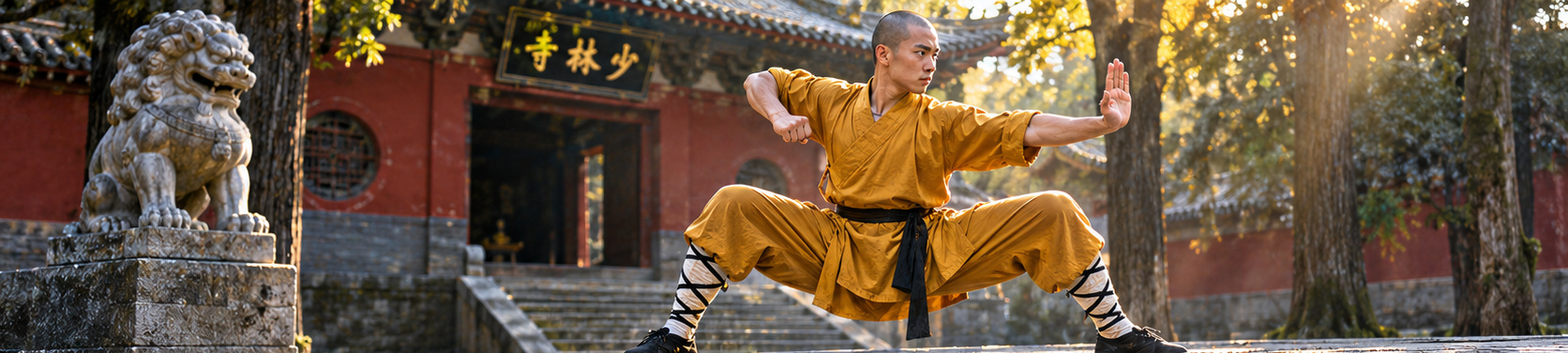
A student stands in a courtyard at sunrise, holding a low stance while practicing punches. Every movement is repeated until the legs begin to shake. Elsewhere, an older woman moves slowly through a park, shifting her weight from one foot to the other. In a training hall, two athletes exchange kicks, punches and throws while their coach watches. All three may be practicing Chinese martial arts.
To audiences around the world, Chinese kung fu (中国功夫, Zhōngguó gōngfu) often means spectacular fighting: lightning-fast punches, spinning kicks and warriors who seem able to defy gravity. But Chinese martial arts include fighting systems, performance routines, competitive sports, traditional weapons, physical conditioning and practices associated with health and self-cultivation. To understand kung fu, we first need to understand what the term actually means.
What Does Kung Fu Really Mean?
The Chinese word 功夫 (gōngfu) does not originally refer only to martial arts. It can describe skill developed through sustained effort, practice and time. A skilled cook, musician or craftsperson can be said to have gongfu in their work. In everyday English, however, “kung fu” has become a familiar name for Chinese martial arts.
The more precise Chinese term is 武术 (wǔshù), referring to martial techniques or arts. In modern usage, wushu can refer broadly to Chinese martial arts or more specifically to standardized sporting disciplines. Traditional martial arts, meanwhile, describes diverse systems passed down through teachers, families, schools and communities.
There is no single martial art called “kung fu” with one universal set of techniques. Learning Wing Chun is different from learning Taijiquan, and practicing a modern wushu routine is different from preparing for a sanda competition.
How Old Is Chinese Kung Fu?
Chinese martial traditions developed over many centuries. Their history includes military training, wrestling, armed combat, village self-defense, public demonstrations and organized physical education. Ancient Chinese texts and material culture provide evidence of weapons and combat techniques, but this does not mean every modern style survived unchanged for thousands of years. Many familiar systems took recognizable form, or were reorganized, much later.
From Warfare to Civilian Practice
Throughout imperial Chinese history, soldiers trained with spears, swords, bows and polearms. Combat skills also circulated among civilian communities. Local militias, security escorts, teachers and martial practitioners helped preserve and adapt techniques. Martial traditions could serve practical purposes, but were also connected with festivals, performances, local identity and personal training. As firearms transformed warfare, unarmed martial arts and traditional weapons continued to develop in other settings.
The Rise of Modern Martial Arts Organizations
During the late nineteenth and early twentieth centuries, martial arts became increasingly associated with physical education, national identity and public demonstrations. The Jingwu Athletic Association, established in Shanghai in 1910, helped promote systematic instruction. Standardized forms and competition rules later contributed to modern sport wushu. The International Wushu Federation was established in 1990. Traditional schools, community groups, sports teams, universities and independent instructors now all contribute to Chinese martial arts.
Shaolin Kung Fu: The Most Famous Name
Few places are as closely associated with Chinese kung fu as Shaolin Temple (少林寺, Shàolín Sì), in the Songshan mountain area near Dengfeng, Henan province. Founded in the late fifth century, Shaolin became an important Buddhist institution and developed a strong association with martial training. Its reputation combines religion, documented martial traditions, popular storytelling and later cultural reinvention.
Did Shaolin Monks Invent Kung Fu?
No. Martial practices existed in China long before Shaolin Temple was founded. Shaolin is influential in the history of certain martial traditions, but it is not the birthplace of every Chinese martial art. The popular story that Bodhidharma (Damo, 达摩) personally invented Shaolin kung fu is not supported as straightforward historical fact. The relationship between Buddhist practice and martial training developed over time.
What Is Shaolin Kung Fu Like?
Shaolin-related traditions include many routines, training methods and weapon practices. Depending on the school, practitioners may study:
- Basic stances and footwork
- Punches, kicks and defensive movements
- Flexibility, balance and physical conditioning
- Empty-hand forms
- Staff and other traditional weapon routines
- Partner exercises and martial applications
The low horse stance, 马步 (mǎbù), is recognizable but not unique to Shaolin. Shaolin demonstrations may show remarkable athleticism, yet demonstrations are not the whole of training and do not establish supernatural abilities.
Wudang Martial Arts: Mountains, Legends and Internal Training
Wudang (武当, Wǔdāng), associated with the Wudang Mountains in Hubei province, is another famous name. The mountains are an important center of Daoist religious culture. In martial arts fiction, Wudang is often contrasted with Shaolin: softness and balance against direct power. This contrast is influential in popular culture, but history is more complicated. Wudang-associated traditions vary, and the idea that all Shaolin arts are “external” while all Wudang arts are “internal” is too rigid.
The legendary Daoist figure Zhang Sanfeng is frequently linked to the origins of Taijiquan, but those stories should not be mistaken for a firmly documented account of its invention. The Wudang Mountains remain culturally important, with martial arts instruction and demonstrations forming part of their contemporary identity.
Five Chinese Martial Arts Styles Worth Knowing
Chinese martial arts include numerous traditions. The following five offer a useful introduction to their diversity. The illustrations are representative artistic interpretations, not a definitive guide to each school’s technique.
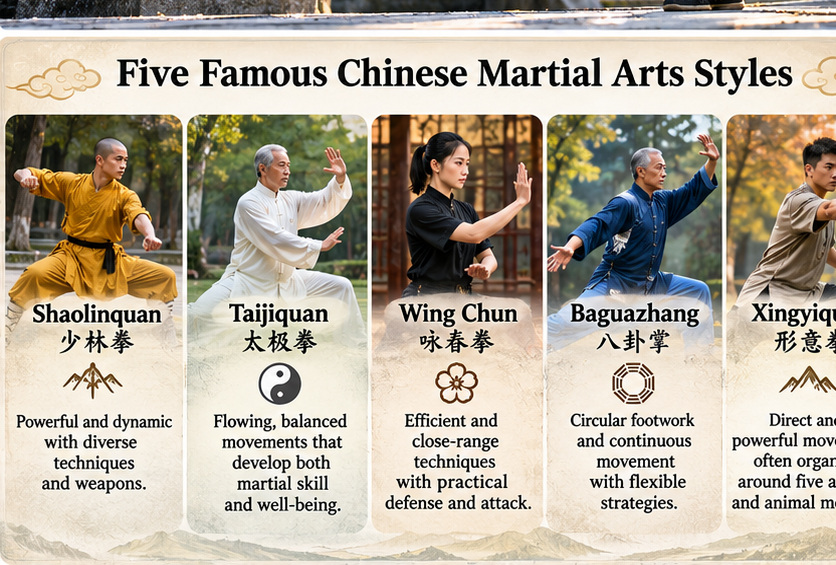
1. Shaolinquan — 少林拳
Shaolinquan is a broad family of martial traditions associated with Shaolin. It is often recognized for dynamic movement, powerful stances, kicking, punching and weapon routines. The curriculum depends on the school and lineage; it is not one standardized style taught identically everywhere.
2. Taijiquan — 太极拳
Taijiquan, commonly called Tai Chi in English, is known for controlled, flowing movements and an emphasis on balance, coordination and body mechanics. It also has a martial dimension, including partner training and applications. Some practitioners focus on health and movement quality, while others study fighting methods. Major traditions include Chen, Yang, Wu, Wu/Hao and Sun styles. UNESCO inscribed Taijiquan on its Representative List of the Intangible Cultural Heritage of Humanity in 2020.
3. Wing Chun — 咏春拳
Wing Chun, or Yongchunquan in Mandarin, is associated particularly with southern Chinese martial arts. It is known for close-range hand techniques, coordinated defense and attack, and efficient movement. Training may include structured forms, partner drills and chi sao (“sticky hands”). It became internationally famous partly through Bruce Lee and films about Ip Man. Different lineage histories mix documented developments with stories that are difficult to verify.
4. Baguazhang — 八卦掌
Baguazhang means “Eight Trigrams Palm.” It is associated with circular stepping, changes of direction and coordinated whole-body movement. Circle walking is a recognizable training method, but the art also includes martial techniques, partner work and different strategic approaches. It developed into a recognizable tradition during the nineteenth century.
5. Xingyiquan — 形意拳
Xingyiquan, often translated as “Form-Intent Boxing,” is known for relatively direct movements and coordinated power. Many lineages organize training around five foundational actions and animal-inspired methods. Their purpose is not to imitate animals literally, but to organize techniques, body mechanics and tactical ideas.
Is Tai Chi Really a Martial Art?
Yes. The slow movements often seen in parks are part of a broader martial tradition. Taijiquan includes strikes, balance disruption, body positioning and partner interaction. One well-known partner practice is 推手 (tuīshǒu), or pushing hands, in which practitioners use controlled contact to develop sensitivity to pressure, timing and changes in balance.
Practicing slow forms alone does not automatically make someone an effective fighter. Practical fighting ability depends on training structure, including appropriate partner drills and progressive resistance. A person attending a gentle community class and someone studying martial applications may both practice Taijiquan, but their training experiences differ.
Northern and Southern Kung Fu: Is There a Difference?
A popular saying describes northern martial arts as emphasizing kicks and southern martial arts as emphasizing punches. This is a broad stereotype, not a dependable classification rule. Some northern traditions feature extended movements and varied kicks; certain southern traditions emphasize close-range hands and stable footwork. Yet there are many exceptions. Geography, lineage, local training culture and individual teaching methods matter more than the slogan alone.
Traditional Kung Fu vs. Modern Competitive Wushu
A modern wushu competition may feature difficult jumps, high kicks, rapid turns and precisely timed sequences. This is one important form of Chinese martial arts, but it is not identical to every traditional practice. Competitive wushu has two major disciplines: taolu, or forms competition, and sanda, or full-contact combat sport. Traditional martial arts may also use forms and partner fighting drills, so these competitive categories should not be treated as the only ways to practice kung fu.
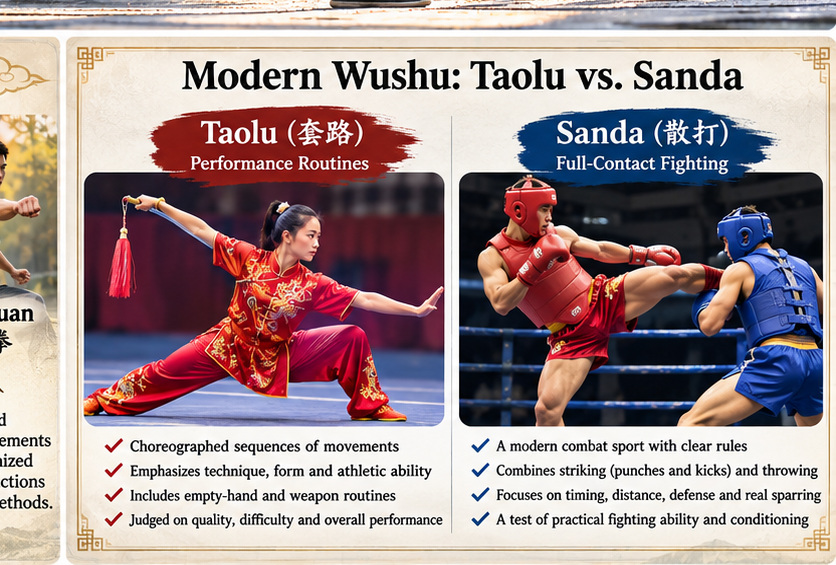
Taolu — 套路: Forms Competition
Taolu refers to organized sequences of martial movements. In competition, athletes are evaluated on technical quality, overall performance and, where applicable, difficulty. Routines may include punches, kicks, stances, jumps, balances and traditional weapons. They require considerable athletic ability. Historically, forms also helped preserve techniques and tactical ideas within lineages. A well-executed routine, however, does not by itself demonstrate effectiveness against a resisting opponent.
Sanda — 散打: Full-Contact Fighting
Sanda is a modern combat sport developed from Chinese martial arts techniques. Under competition rules, athletes use punches, kicks, throws and wrestling-related techniques. They train timing, distance, defense, conditioning and performance against resisting opponents. A sanda bout differs visibly from a choreographed demonstration. Taolu and sanda test different skills; neither alone defines the value of every traditional martial art.
Traditional Weapons of Chinese Kung Fu
Weapons have played a major role in Chinese martial history. Four recognizable categories include:
- 剑 (jiàn) — Straight sword: commonly a double-edged blade, used for cutting and thrusting in different traditions.
- 刀 (dāo) — Saber: commonly a single-edged blade, with historical variations in shape and use.
- 枪 (qiāng) — Spear: a major military weapon that remains important in martial arts routines.
- 棍 (gùn) — Staff: strongly associated with Shaolin imagery, but practiced far beyond Shaolin.
Modern demonstrations may use specialized performance equipment rather than historical battlefield weapons. Beginners should not attempt weapon training without qualified instruction and suitable safety measures.
The Philosophy of Kung Fu: Discipline, Respect and Martial Ethics
Chinese martial arts are often associated with discipline, patience, self-control and respect. The term 武德 (wǔdé), or martial virtue, may include respecting teachers and training partners, avoiding unnecessary aggression and using skills responsibly. Interpretations vary among schools.
Some Shaolin traditions are associated with Chan Buddhism, Wudang martial culture with Daoism, and Taijiquan with ideas such as yin and yang, balance and coordinated movement. Not every school teaches the same philosophy, and not every practitioner approaches training as spiritual practice. A sanda athlete may prioritize sport performance while another student values cultural preservation. Cultivated skill is a thread connecting these different approaches.
Kung Fu in Chinese Movies: What Is Real?
Bruce Lee helped transform the global image of Chinese martial arts through his films and distinctive approach to combat. Jackie Chan became famous for combining martial arts, acrobatics, physical comedy and stunt work. Jet Li brought elite wushu performance experience into action cinema. Films such as Crouching Tiger, Hidden Dragon introduced international audiences to martial arts fiction through elaborate choreography.
Can Kung Fu Masters Really Fly?
No. Leaping across rooftops or floating through the air belongs to 武侠 (wǔxiá), martial arts hero fiction. Wuxia stories feature extraordinary abilities, codes of honor, wandering heroes and conflicts over justice. Wire work, editing and visual effects make impossible movements appear convincing. Real martial artists can develop impressive strength, speed, balance, flexibility and coordination, but not supernatural flight or immunity to injury.
Are Movie Fight Scenes Real Fighting?
Film choreography and competitive fighting serve different purposes. Movie action must communicate clearly to an audience, protect performers and fit a story. Real fighting involves resistance, fatigue, uncertainty and unpredictable reactions. A skilled action performer may not be a competitive fighter, and an accomplished fighter may have little experience with complex choreography. Their skills overlap but are not identical.
Can Foreigners Learn Kung Fu in China?
Yes. Many schools and instructors accept international students, but programs vary. Some focus on modern wushu performance; others emphasize traditional forms, cultural immersion, Taijiquan or sanda. A short tourist lesson is not equivalent to months or years of structured training.
Where Can You Learn?
- Dengfeng, Henan — The area around Shaolin Temple has schools and demonstrations associated with Shaolin training.
- Wudang Mountains, Hubei — Some schools offer Wudang-associated martial arts and movement practices; curricula vary.
- Chenjiagou, Henan — This village in Wenxian County is strongly associated with Chen-style Taijiquan.
- Major Chinese cities — Beijing, Shanghai, Guangzhou and other cities have martial arts schools, clubs and instructors.
You do not need to travel to a remote mountain temple to begin learning. Check current course availability, credentials and conditions directly with any school before making travel plans.
How to Choose a Good School
- Which martial arts style will be taught?
- Is the program focused on performance, self-defense, combat sport or health?
- What are the instructors’ qualifications and teaching experience?
- Is instruction available in a language you understand?
- How much partner practice is included?
- What safety equipment and injury procedures are provided?
- Are accommodation, meals and additional fees included?
Be cautious of schools promising extraordinary fighting abilities after only a few days. A trustworthy instructor should explain the training methods and realistic outcomes.
What Should Beginners Expect from Their First Class?
A beginner’s first class may look less dramatic than a movie. Much of the time may be spent learning to stand, move, turn and maintain balance. Common training elements include:
- 马步 (mǎbù) — Horse stance: developing stability and leg endurance.
- 步法 (bùfǎ) — Footwork: moving with balance and control.
- 基本功 (jīběngōng) — Basic skills: conditioning, flexibility and fundamental movements.
- 套路 (tàolù) — Forms: practicing organized sequences of techniques.
- 对练 (duìliàn) — Partner practice: working on coordinated movements and applications.
Physical intensity and contact should match the class and student’s experience. Beginners should progress gradually rather than attempting advanced jumps, deep stretches or contact sparring without preparation.
Useful Mandarin for Learning Kung Fu
These words and expressions will help you understand basic instructions in a Chinese martial arts class:
- 功夫 — gōngfu — Kung fu; cultivated skill
- 武术 — wǔshù — Martial arts
- 少林拳 — Shàolínquán — Shaolin boxing
- 太极拳 — tàijíquán — Tai Chi
- 咏春拳 — yǒngchūnquán — Wing Chun
- 师傅 — shīfu — Master or skilled instructor
- 教练 — jiàoliàn — Coach
- 马步 — mǎbù — Horse stance
- 基本功 — jīběngōng — Basic skills
- 套路 — tàolù — Form or routine
- 散打 — sǎndǎ — Sanda
- 练习 — liànxí — To practice
- 慢一点 — màn yìdiǎn — A little slower
- 再来一次 — zài lái yí cì — One more time
Five Useful Sentences
我想学中国功夫。 — Wǒ xiǎng xué Zhōngguó gōngfu. — “I want to learn Chinese kung fu.”
这里有初学者课程吗? — Zhèlǐ yǒu chūxuézhě kèchéng ma? — “Do you have classes for beginners here?”
这个动作怎么做? — Zhège dòngzuò zěnme zuò? — “How do I do this movement?”
请慢一点。 — Qǐng màn yìdiǎn. — “Please go a little slower.”
我可以再试一次吗? — Wǒ kěyǐ zài shì yí cì ma? — “Can I try again?”
Frequently Asked Questions
Is kung fu the same as karate?
No. Kung fu is the common international term for Chinese martial arts. Karate developed in Okinawa and became associated with Japanese martial arts traditions. Both encompass different styles and historical influences.
Is Tai Chi a type of kung fu?
Yes. Taijiquan is a Chinese martial art, although many people practice it primarily for movement, balance or well-being.
Is Shaolin the oldest martial art in China?
That would be misleading. Martial practices existed in China long before Shaolin Temple was founded. Shaolin is historically influential but not the origin of all Chinese martial arts.
What is the difference between kung fu and wushu?
Kung fu is the familiar popular term in international English. Wushu is the Chinese term for martial arts and also refers to modern competitive disciplines such as taolu and sanda.
Can kung fu be effective in real fighting?
Effectiveness depends on the system, instructor and training methods. Techniques practiced against resisting partners under appropriate conditions are more directly relevant to fighting than choreography alone.
How long does it take to learn kung fu?
Basic movements can be introduced in a few lessons, but coordination, strength, timing and technical proficiency generally require sustained training over months and years. There is no universal timetable for mastery.
Do kung fu practitioners use weapons?
Many Chinese martial arts traditions include weapons, but not all schools teach them. Weapon training requires appropriate instruction and safety precautions.
Do you need to be young or flexible to start?
Not necessarily. Different styles and classes offer different physical demands. Beginners should choose instruction appropriate to their mobility, fitness and health circumstances.
The Real Meaning of Kung Fu
The most memorable image of kung fu may be a spectacular flying kick. But its deeper story is often quieter: a student repeating a stance after everyone else has left, a teacher correcting the position of a hand, two training partners learning to move without losing balance, or an older practitioner continuing a familiar Taijiquan routine in a neighborhood park.
Chinese martial arts have changed as society, technology and cultural expectations have changed. They can be methods of combat, competitive sports, artistic performances, community traditions or ways of cultivating movement and discipline. No single experience represents them all.
Perhaps the most useful lesson is hidden in the word gongfu itself. Skill does not appear through a secret technique or a dramatic moment of inspiration. It grows through attention, practice, correction and time. That is a meaning anyone can appreciate, whether they ever learn to throw a punch or not.
Further Reading
- International Wushu Federation — Sport Wushu, Taolu and Sanda: https://iwuf.org/en/sport-wushu/competitive-wushu/
- UNESCO Intangible Cultural Heritage — Taijiquan (2020): https://ich.unesco.org/en/RL/taijiquan-00424
- Meir Shahar — The Shaolin Monastery: History, Religion, and the Chinese Martial Arts
- Stanley E. Henning — Academia Encounters the Chinese Martial Arts