Chinese Calligraphy for Beginners: History, Five Scripts and How to Write with a Brush
Discover Chinese calligraphy, the five major scripts, Four Treasures of the Study, brush techniques, famous masters and practical beginner exercises.
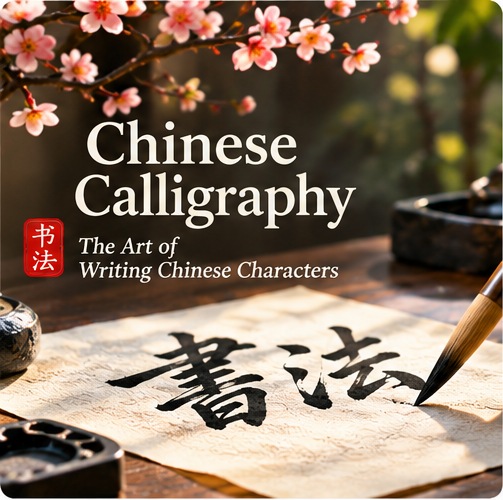
A brush touches a sheet of white paper. A dark line appears, grows thicker under pressure, then becomes thin as the brush lifts. The movement seems simple, yet a calligrapher may spend years learning how to create a single stroke.
In Chinese calligraphy, the movement matters as much as the mark it leaves behind. Two artists can write exactly the same character and produce works with completely different personalities.
Chinese calligraphy (书法, shūfǎ) is an art in which writing becomes visual expression. You do not need to read classical Chinese or own expensive equipment to appreciate it. Recognizing a few scripts and understanding how a brush moves can transform the way you see Chinese characters.
What Is Chinese Calligraphy?
Chinese calligraphy is the artistic practice of writing Chinese characters, traditionally with brush and ink. The word 书法 (shūfǎ) refers to the methods or art of writing.
Unlike ordinary handwriting, calligraphy places particular attention on form, movement, rhythm, balance and expressive quality. The artist decides how a stroke begins, how much pressure to apply, how quickly to move and how to finish.
A calligrapher also considers how strokes fit within a character, how characters relate to one another and how the writing occupies the surrounding space. A calligraphic work is not simply a collection of attractive characters: it is a composition.
Why Is Calligraphy Important in Chinese Culture?
For much of imperial Chinese history, literacy and mastery of the written word were closely connected with education, scholarship, government and social standing. Educated people studied classical texts, wrote poetry, exchanged letters and copied important writings.
Calligraphy became a way to demonstrate learning, taste, discipline and personal expression. The same brush and ink were used in Chinese painting, creating a close relationship between the two arts.
Calligraphy was admired not only for what it said but for the skill and character thought to be visible in the writing. Today, the art is practiced far beyond the circles of scholars and officials.
A Short History of Chinese Calligraphy
The history of calligraphy is connected to the Chinese writing system, which stretches back more than 3,000 years. The surviving evidence shows change and experimentation rather than one unbroken, unchanging style.
From Oracle Bones to Written Art
Some of the earliest surviving systematic Chinese writing appears on oracle bones from the late Shang dynasty. Characters were inscribed on animal bones and turtle shells, often in connection with divination. Bronze inscriptions became another important form of early writing.
These inscriptions are essential to the history of Chinese characters, but they should not be confused with the fully developed art of brush calligraphy. As tools, materials and scripts changed, new expressive possibilities emerged.
The Qin and Han Dynasties
During the Qin dynasty (221–206 BCE), small seal script became an important standardized writing form. In the Han dynasty (206 BCE–220 CE), clerical script became widely used and helped shape later writing.
The flexible brush allowed varied line widths, changes in pressure and distinctive stroke endings. Writing increasingly became an art of controlled movement as well as a means of recording information.
The Age of Great Calligraphers
Wang Xizhi (王羲之, Wáng Xīzhī), who lived in the fourth century, is traditionally honored as the Sage of Calligraphy. His most famous associated work is the Preface to the Poems Collected from the Orchid Pavilion (兰亭集序, Lántíng Jí Xù).
The original is not known to survive. Its influence was transmitted through later copies, tracings and reproductions. When you see the famous work in a book or exhibition, you are normally seeing that transmission rather than Wang's surviving original sheet.
During the Tang dynasty (618–907), regular script reached a highly refined form. Ouyang Xun, Yan Zhenqing and Liu Gongquan became enduring models. Later generations studied and reinterpreted these masters instead of simply repeating them.
The Five Major Styles of Chinese Calligraphy
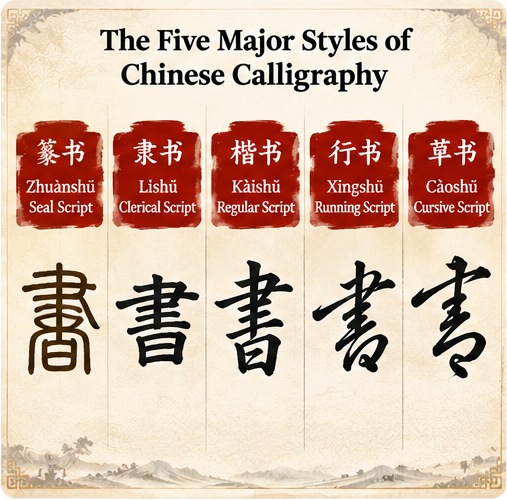
The five familiar categories are not five separate writing systems. They are historical and artistic ways of forming Chinese characters.
1. Seal Script — 篆书 (Zhuànshū)
Seal script is associated with early standardized writing. Characters often appear elongated, with relatively even lines and carefully organized structures. It remains recognizable on carved seals and artworks inspired by ancient inscriptions.
What to notice: symmetry, curves and formal structure.
2. Clerical Script — 隶书 (Lìshū)
Clerical script became important during the Qin and Han periods. It often features broad, relatively flat structures and distinctive horizontal strokes. Some strokes end in a flaring movement traditionally described with the imagery of a silkworm's head and a wild goose's tail.
What to notice: wide shapes, horizontal movement and expressive stroke endings.
3. Regular Script — 楷书 (Kǎishū)
Regular script is a practical starting point for beginners. Its strokes are clearly distinguished and its structures relatively easy to recognize. It resembles standard modern character forms, although brush-written regular script has its own artistic conventions.
What to notice: distinct strokes, balanced proportions and disciplined structure.
4. Running Script — 行书 (Xíngshū)
Running script is more fluid than regular script. Strokes may be simplified or connected, and the brush moves more continuously. It can remain readable while allowing spontaneity and personal rhythm.
What to notice: connections, flow and the movement between characters.
5. Cursive Script — 草书 (Cǎoshū)
Cursive script is highly abbreviated and expressive. Strokes may merge and characters can differ greatly from standard forms. Despite its apparent freedom, skilled cursive calligraphy follows conventions: it is not simply careless or fast writing.
What to notice: energy, continuity and deliberate control beneath spontaneity.
For most people new to Chinese characters and brush writing, regular script is the most useful starting point. Museums may also include oracle-bone writing in broader historical surveys; the familiar five-style grouping refers to seal, clerical, regular, running and cursive scripts.
The Four Treasures of the Study
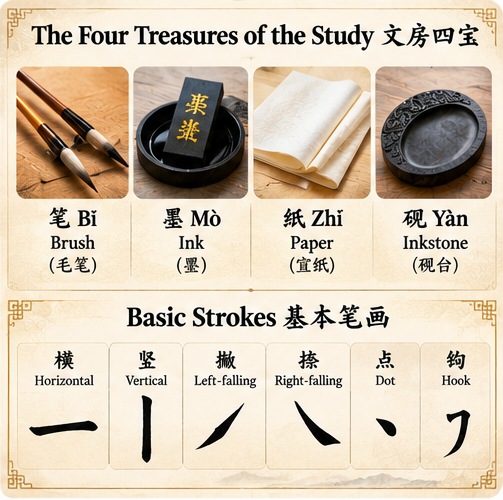
Traditional Chinese calligraphy uses four essential tools, collectively called 文房四宝 (wénfáng sìbǎo), the Four Treasures of the Study.
Brush — 笔 (Bǐ)
The traditional writing brush is a 毛笔 (máobǐ). Its flexible tip responds to pressure, direction and speed. Unlike a ballpoint pen, it can create dramatically different line widths. Brushes vary in size, stiffness, hair type and absorbency. A medium-sized, affordable practice brush is enough to start.
Ink — 墨 (Mò)
Traditional ink is often prepared by grinding an ink stick with water on an inkstone. The artist can adjust its concentration. Bottled liquid ink is a practical beginner alternative that lets you focus on controlling the brush.
Paper — 纸 (Zhǐ)
Calligraphy is closely associated with Xuan paper (宣纸, xuānzhǐ), although many other papers are used. Different surfaces absorb ink differently. Highly absorbent paper may make stroke edges spread; less absorbent paper can provide more control. Inexpensive practice paper is sufficient for a first lesson.
Inkstone — 砚 (Yàn)
An inkstone is a surface for grinding ink with water. Some are valued as collectible art objects. If you use bottled ink, a simple ink dish is enough. Expensive equipment is not a requirement for learning.
How to Hold a Chinese Calligraphy Brush
A brush is generally held more upright than an ordinary pen. The fingers control it while the hand, wrist and arm guide movement. Exact grips and arm positions vary by teaching tradition, brush size and the scale of the work.
Begin with relaxed shoulders and a comfortable seated position. Hold the brush securely without squeezing it. Keep it relatively upright, allow the wrist and arm to move naturally, and practice slow strokes before attempting speed.
The goal is control, not force. Excessive tension makes subtle changes in pressure harder.
The Eight Basic Strokes of Chinese Characters
A traditional introductory framework is the Eight Principles of Yong (永字八法, Yǒngzì Bāfǎ). It uses 永 (yǒng), meaning forever, to demonstrate eight fundamental brush techniques.
Beginner-friendly descriptions include dot, horizontal, vertical, hook, rising, left-falling, right-falling and turning movements. Traditional terminology is more specialized, and different teaching diagrams can simplify it differently.
The model is useful because several kinds of movement appear within one character. It does not mean that all Chinese writing consists of only eight possible strokes.
How to Write Your First Chinese Characters
一 (Yī) — One
One horizontal line is harder than it looks. Practice how the brush touches the paper, travels and lifts. Watch the beginning and ending rather than drawing a line as quickly as possible.
十 (Shí) — Ten
A horizontal and vertical stroke introduce the relationship between intersecting lines. Try to keep the structure balanced rather than merely drawing a cross.
人 (Rén) — Person
Two falling strokes introduce angle, direction and negative space. Notice how the two strokes differ and how the empty area between them shapes the character.
中 (Zhōng) — Middle; China
The vertical line passes through the central enclosure. This is a useful exercise in alignment and the relationship between inner and outer space.
永 (Yǒng) — Forever
Once you are comfortable with simple characters, practice 永 as a collection of different brush movements. Do not worry about perfection on your first attempt.
A Simple 15-Minute Practice Session
- 3 minutes: warm up with horizontal and vertical strokes.
- 4 minutes: practice dots, falling strokes and hooks.
- 5 minutes: repeat 一, 十 and 人.
- 3 minutes: compare your work with a reliable regular-script model.
Choose one feature to improve each day. For example, focus on keeping horizontal strokes steady rather than trying to correct everything at once.
Understanding Chinese Stroke Order
Stroke order is important in both everyday handwriting and calligraphy. Common patterns include writing from top to bottom and left to right, and placing certain horizontal strokes before intersecting vertical strokes.
These are general principles, not a complete algorithm for every character. Individual characters have established orders, and conventions can differ by script or regional standard. Consult a reliable stroke-order reference when learning a new character.
Correct stroke order helps make writing consistent and supports smoother movement.
How to Appreciate a Calligraphy Artwork
You do not have to read every character to appreciate the work. Start with four things.
Brushwork
Are strokes thick, thin, dry, wet, smooth or textured? A skilled calligrapher can vary these qualities deliberately.
Structure
How do the strokes fit within each character? Some feel stable and symmetrical; others deliberately lean or stretch.
Rhythm
How does your eye move from one character to the next? Size, spacing and direction can create a feeling of speed or stillness.
Empty Space
Blank areas around and between characters are part of the composition. What remains unwritten can be as important as the ink.
Famous Chinese Calligraphers to Know
Wang Xizhi — 王羲之
Revered as the Sage of Calligraphy, Wang Xizhi is especially associated with running script and the tradition surrounding the Orchid Pavilion Preface.
Yan Zhenqing — 颜真卿
A major Tang-dynasty calligrapher whose powerful regular script remains an important model for students.
Liu Gongquan — 柳公权
Another influential Tang master, admired for firm structure and controlled elegance.
Su Shi — 苏轼
A Song-dynasty poet, writer, official and calligrapher whose work illustrates the relationship between literature, personality and brush expression.
Mi Fu — 米芾
A celebrated Song calligrapher recognized for distinctive brushwork and artistic judgment, particularly in running script.
Calligraphy and Chinese Painting
Chinese calligraphy and ink painting share materials and brush techniques. In traditional literati culture, poetry, calligraphy and painting were often combined in a single artwork.
An artist might paint a landscape, write a poem or inscription and add a seal. The writing shapes the meaning of the painting, while the image provides context for the words. This relationship is more than decoration.
Where Can You See Chinese Calligraphy Today?
Calligraphy remains visible in museums, temples, gardens, exhibitions and private homes. At Chinese New Year, people display red-paper spring couplets (春联, chūnlián) around doorways.
It also appears in signs, festivals, contemporary design and public art. Visitors may find beginner workshops in cultural centers, museums and studios. Ask whether materials are included and whether the class is suitable for first-timers.
Is Chinese Calligraphy Difficult to Learn?
It takes time to become proficient, but beginners can enjoy it immediately. The challenge is coordinating brush, ink, movement and character structure. Unlike typing, brush writing leaves visible traces of pressure, speed and hesitation.
Mistakes are easy to notice, but so is improvement. You do not need professional mastery to appreciate the art. Learning a few strokes can deepen your understanding of Chinese characters.
Useful Mandarin for Chinese Calligraphy
- 书法 (shūfǎ) — calligraphy
- 毛笔 (máobǐ) — writing brush
- 墨 (mò) — ink
- 宣纸 (xuānzhǐ) — Xuan paper
- 砚台 (yàntai) — inkstone
- 汉字 (Hànzì) — Chinese character
- 笔画 (bǐhuà) — stroke
- 笔顺 (bǐshùn) — stroke order
- 楷书 (kǎishū) — regular script
- 行书 (xíngshū) — running script
- 草书 (cǎoshū) — cursive script
- 练字 (liàn zì) — practice writing characters
- 临摹 (línmó) — copy from a model
Five Useful Sentences
- 我想学书法。 (Wǒ xiǎng xué shūfǎ.) — I want to learn calligraphy.
- 这个字怎么写? (Zhège zì zěnme xiě?) — How do you write this character?
- 这个字有几画? (Zhège zì yǒu jǐ huà?) — How many strokes does this character have?
- 请教我正确的笔顺。 (Qǐng jiāo wǒ zhèngquè de bǐshùn.) — Please teach me the correct stroke order.
- 我可以试一下吗? (Wǒ kěyǐ shì yíxià ma?) — May I give it a try?
Frequently Asked Questions
Is Chinese calligraphy the same as handwriting?
Not exactly. Both involve Chinese characters, but calligraphy emphasizes artistic form, brushwork, composition and expression.
What are the five styles of Chinese calligraphy?
Seal, clerical, regular, running and cursive script.
Which style is best for beginners?
Regular script is generally the most practical because its strokes and structures are clearly defined.
Do I need to know Chinese?
No. You can begin practicing simple characters while learning their meanings. Language knowledge deepens appreciation over time.
Can I learn calligraphy with a pen?
You can practice structure and stroke order with a pen, but traditional brush calligraphy requires techniques specific to a flexible brush.
Who is the most famous Chinese calligrapher?
Wang Xizhi is one of the most celebrated figures and is traditionally called the Sage of Calligraphy.
What are the Four Treasures?
Brush, ink, paper and inkstone.
Is calligraphy still practiced?
Yes. It remains an important artistic tradition and a visible part of contemporary Chinese cultural life.
The Art of Paying Attention
At first glance, calligraphy appears to be an art of making marks on paper. Its deeper fascination lies in the attention behind those marks.
A stroke records the movement of a hand, the pressure of a brush and a decision made in a particular moment. Generations of artists have studied the same characters and found new ways to express themselves.
For a beginner, the most important step is not to produce a perfect character. It is to notice how the brush moves, how ink responds and how small changes create different results. That is where the art begins.
Further Reading
- The Metropolitan Museum of Art — Chinese Calligraphy, by Dawn Delbanco.
- Smithsonian National Museum of Asian Art — resources on Chinese calligraphic arts.
- Asian Art Museum, San Francisco — introductory resources on Chinese calligraphy.